In Greek mythology, there was a King called Sisyphus of Ephyra. He was cunning and deceitful; so cunning in fact that he twice outmaneuvered death itself. The gods, unimpressed by his deceit, sentenced him to an eternity in Tartarus. His sentence was deceptively simple. He was to roll a large boulder up a steep hill. But every time he neared the summit to complete the task, the weight would become unbearable, the boulder would slip, and it would roll back to the bottom. Sisyphus would then turn around, walk back down, and begin again. This went on forever.
The philosopher Albert Camus wrote about Sisyphus in 1942. You would be forgiven if you think that his interest in Sisyphus was in the punishment and the endless struggle upwards. But it was not. He was interested in the walk back down the hill. That moment of full consciousness when Sisyphus descends to meet his boulder again at the bottom of the hill, fully aware it will roll back and the effort is futile yet choosing to begin again. Camus suggests that this is the truest test of the human condition.
The public story
As a nation, it appears we have remained trapped in a collective Sisyphean experience as far as road safety is concerned.
A couple of weeks ago, the National Transport and Safety Authority (NTSA) launched the Instant Fines Traffic Management System (IFTMS). This is an automated enforcement platform that uses surveillance cameras to detect traffic violations, and dispatches SMS notifications and fines to offending motorists without any human intervention. About 1,000 cameras have been deployed along major highways across the country. Fines range from Kshs 500 for minor infractions to Kshs 10,000 for more serious violations.
Motorists who fail to pay within seven days face interest charges and are barred from accessing NTSA services until all outstanding penalties are cleared.
Predictably, the boulder has already slipped, and we are walking back down the hill because shortly after deployment of IFTMS, a case was filed in the High Court and conservatory orders issued suspending the entire system. The argument was that the system violates motorists constitutional rights. The matter has still not finally been determined in court.
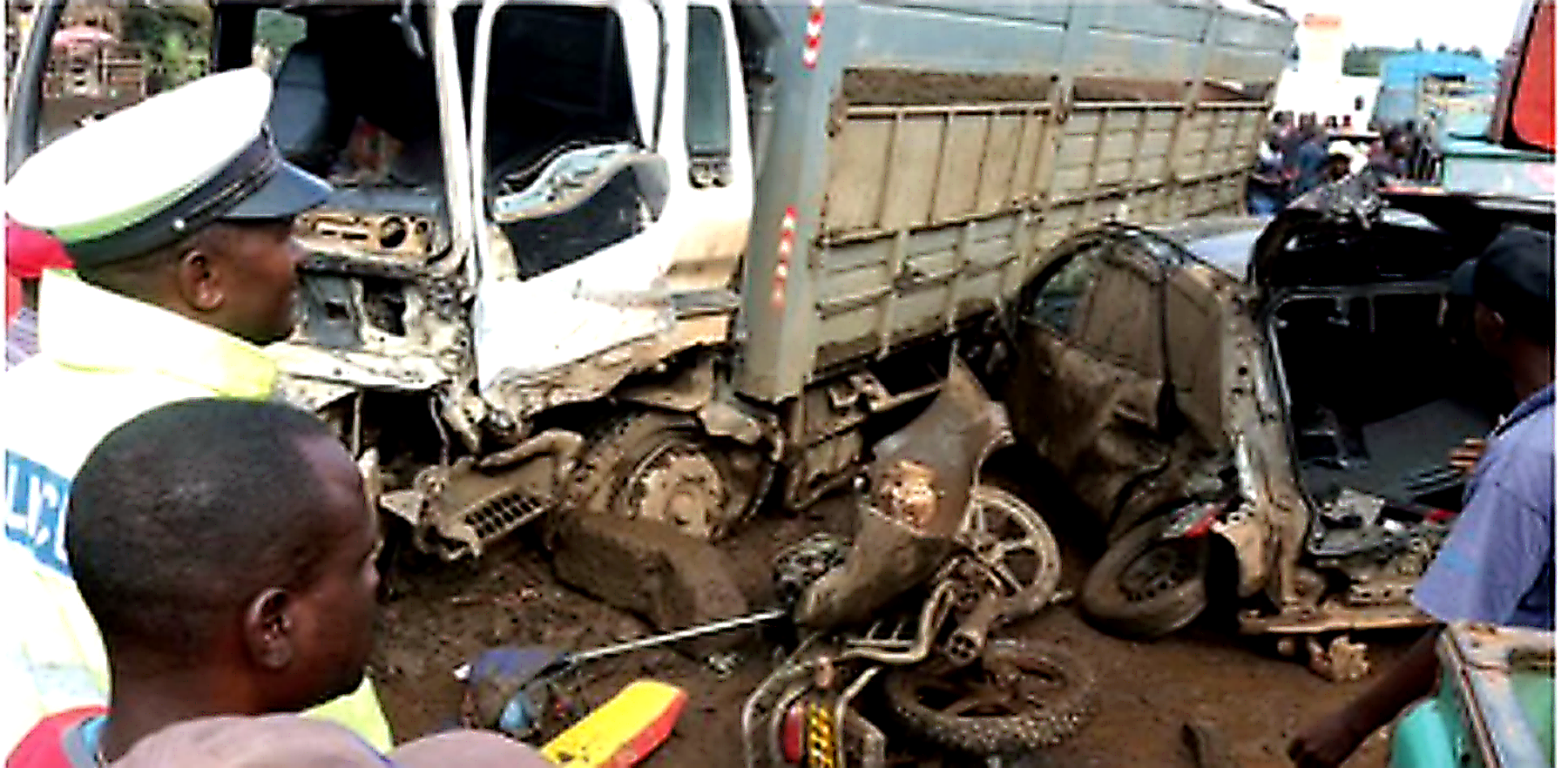
As a body politic, we are currently engaged in a dialogue of the deaf while our roads become a conveyor belt of tragedy. Let us examine the ledger of our national loss. In 2025, Kenya recorded 5,009 road deaths. This is not a statistical estimate, but a definitive count of human beings who left their homes one morning and simply never returned. This represents a 3.4% increase from 2024, continuing a grim, multi-year upward trajectory of blood on our tarmac.
The data reveals a specific vulnerability. Pedestrians remain our most frequent victims, while motorcyclist fatalities surged by 8.8% to 1,148. Even the festive season became a period of harvest for the grave, claiming 415 lives, a 23% spike over the previous year. NTSA’s own economists estimate that these accidents drain Ksh 450 billion from our economy annually through medical costs and lost productivity. But make no mistake. This is not a transport statistic. It is a national indictment.
We have neither been oblivious of this crisis, nor been short of solutions. Previously, we had the Michuki Rules of 2003, which reduced road accidents by an estimated 40 per cent, and which sadly collapsed the moment Hon. John Michuki was moved to a different ministry in 2005. We have also had the alcoblow introduced, litigated, withdrawn, and quietly buried. We have had joint festive season operations, roadside crackdowns, multi-agency deployments, and parliamentary committee enquiries. Every minister in this docket inherits the same crisis and unsuccessfully attempts to solve it.
Begs the question. Do we collectively enjoy being Sisyphus? Is the opposition to IFTMS simply rent-protection dressed up as rights? You be the judge.
IFTMS is the first initiative in two decades that attempts to break this cycle structurally rather than managerially. This distinction matters enormously. Kenyan traffic enforcement has largely functioned as a revenue system for enforcement officers rather than a safety system for the public. The Long Distance Drivers and Conductors Association said plainly in January 2026 that NTSA's roadside joint operations have degenerated into extortion points, opportunities for corruption, selective application of the law, intimidation, and harassment.
In April 2025, NTSA itself sent a letter to driving schools admitting that a bribery racket was fleecing learners, with examiners receiving what operators euphemistically called appreciation per student. No examiner was charged nor dismissed.
The deeper logic
This is what human enforcement produces in a low-accountability environment. Not safety. Transactions. The officer and the driver negotiate a price that satisfies both and serves neither the law nor the road user dying in the next crash.
Automation breaks this negotiation. It does not make eye contact, cannot be charmed, and cannot be threatened. IFTMS eliminates these roadside transactions. And that is the part of the debate that is being lost in the constitutional defense excitement.
I submit however, that the petitioners are not entirely wrong. They highlight real problems.
The argument that automated fines presume guilt before a hearing, is a legitimate constitutional point. Article 50 of the Constitution guarantees every accused person the right to be heard. The IFTMS as currently structured, issues, enforces, and restricts access to services without any adjudication. Once fined, there is no immediate mechanism to contest the fine, review the camera evidence, or argue that what was captured was not a violation, but a pothole-avoidance manoeuvre.
The blocking of NTSA services for unpaid fines is an even sharper concern. When a government platform can deny you access to a vehicle inspection certificate, a logbook transfer, or a driving licence renewal until you pay a fine you have not contested in any court, that platform has become judge, jury, prosecutor, and executioner.
And the distributional question must be named clearly. Automated enforcement on highways does not catch the wealthy driver who hires a lawyer and contests every ticket. It catches the people whose income is movement. These are the matatu driver, the boda boda operator, the delivery rider, and the long-haul truck driver. If the fine schedule is designed without considering who is actually on the road, and what a Ksh 10,000 deduction means to their household economy, the system is a revenue instrument dressed in safety language.
However, and this is the argument the court case is obscuring, none of these are reasons to abandon the system and throw out the baby with the bathwater. They are design specifications IFTMS has not yet met.
The United Kingdom's speed camera network issues tens of millions of fines annually. Abu Dhabi's Salik toll-and-camera system is one of the most efficient in the world. None of these systems assumed that automation was incompatible with due process. Each one built an accessible, low-cost appeals pathway directly into the design. Each one published its error rates. Each one made the evidence that included the camera image, the timestamp, the recorded speed, and made it immediately available to the recipient of the fine.
The legitimacy of the system rests not on whether cameras can catch violations. They can. It rests on whether a recipient can contest one at reasonable cost and reasonable speed.
The final test
Finally, my unsolicited advice is twofold. First to NTSA. Use the 90-day window granted by the High Court to engineer due process into the system by undertaking these five things. One, build a publicly accessible, low cost online appeals portal where any motorist can upload their own evidence, contest a fine, and receive a determination within 14 days. Two, evidence disclosure must be immediate and automatic. If an SMS is going to impose a penalty, it should also provide or link to the proof including the camera image, the timestamp, and where relevant, the recorded speed. This should also include publishing the system’s accuracy and error rates for the cameras and number plate recognition. In a low trust environment, transparency is the only brake on suspicion. Three, remove the exclusive KCB payment channel. A fine that can only be paid at a bank branch in 2026 is not a digital system, it is an analogue bottleneck wearing a technology costume. Four, decouple the service-blocking mechanism from unpaid fines pending appeal. Five, consider a graduated fine schedule that reflects income realities. A Ksh 500 fine for a boda boda rider and a Ksh 500 fine for a Range Rover driver, are not the same deterrent, and a system that ignores this is regressive by design.
Second, to the petitioners and the various advocacy groups. Your instinct is correct. The system needs due process built in. But lets ask ourselves. What is the counterfactual being defended? It is the system where traffic enforcement is a negotiation between an officer and a driver at the roadside, where the outcome depends on who is more persuasive, more connected, or more flush with cash. That system killed 5,009 people in 2005 and costed us Ksh 450 billion. Let that sink in. We do not have the luxury to keep pushing this boulder up the hill, only for it to keep rolling back down.
For every complex problem there is an answer that is clear, simple, and wrong - H.L. Mencken