
Irving Paul Lazar was a Hollywood agent nicknamed Swifty. He was not by any conventional measure, the most impressive man in the room. He was short, bespectacled, and lacked the easy magnetism that the entertainment industry treats as currency. But he had something rarer and considerably more dangerous, the absolute refusal to accept that the room's existing hierarchy had any binding authority over his ambitions.
Early in his career, Swifty was at dinner with a young starlet who at the time was in high demand in the movie industry. He wanted to be her agent. So, throughout the evening, he tried everything he possibly could to convince her. But she remained unimpressed and he was running out of moves.
The public story
At one point Swifty excused himself to go to the men’s bathroom. While there, he bumped into Frank Sinatra, who was one of the most popular and influential musical artists having sold more than 150 million records worldwide, and whose attention was the most coveted social commodity at the time. Swifty introduced himself with exuberant passion and exceptional confidence. But Sinatra responded very apathetically with the polite indifference of a man accustomed to being approached by strangers.
Swifty was not disheartened by Frank’s indifference. He persisted and asked Frank to please come and say hello to his table. Sinatra declined. But Swifty insistently asked again and again. Finally, Sinatra caved in.
Swifty then returned to his table. And shortly after, in full view of the entire room, Frank sauntered over to Swifty’s table. “Hi Swifty.” said Sinatra, extending his hand. “Not now Frank,” replied Swifty. The starlet, duly impressed, signed on the dotted line the following day, making Swifty her agent.
Now that, my fellow Kenyans, is what is called chutzpah.
Chutzpah is derived from the Yiddish language. It means audacity. Gall. Nerve. The kind of confidence that borders on arrogance that allows someone to do or say things that appear shocking, precisely because they reveal a total indifference to the existing power arrangement. It is the courage to do something that looks too large for your situation, too bold for your circumstances, and too presumptuous for your critics. It is not recklessness. It is the fearlessness to take on established authority and systems, and to do so with such calculated composure.
This week Kenya executed a chutzpah.
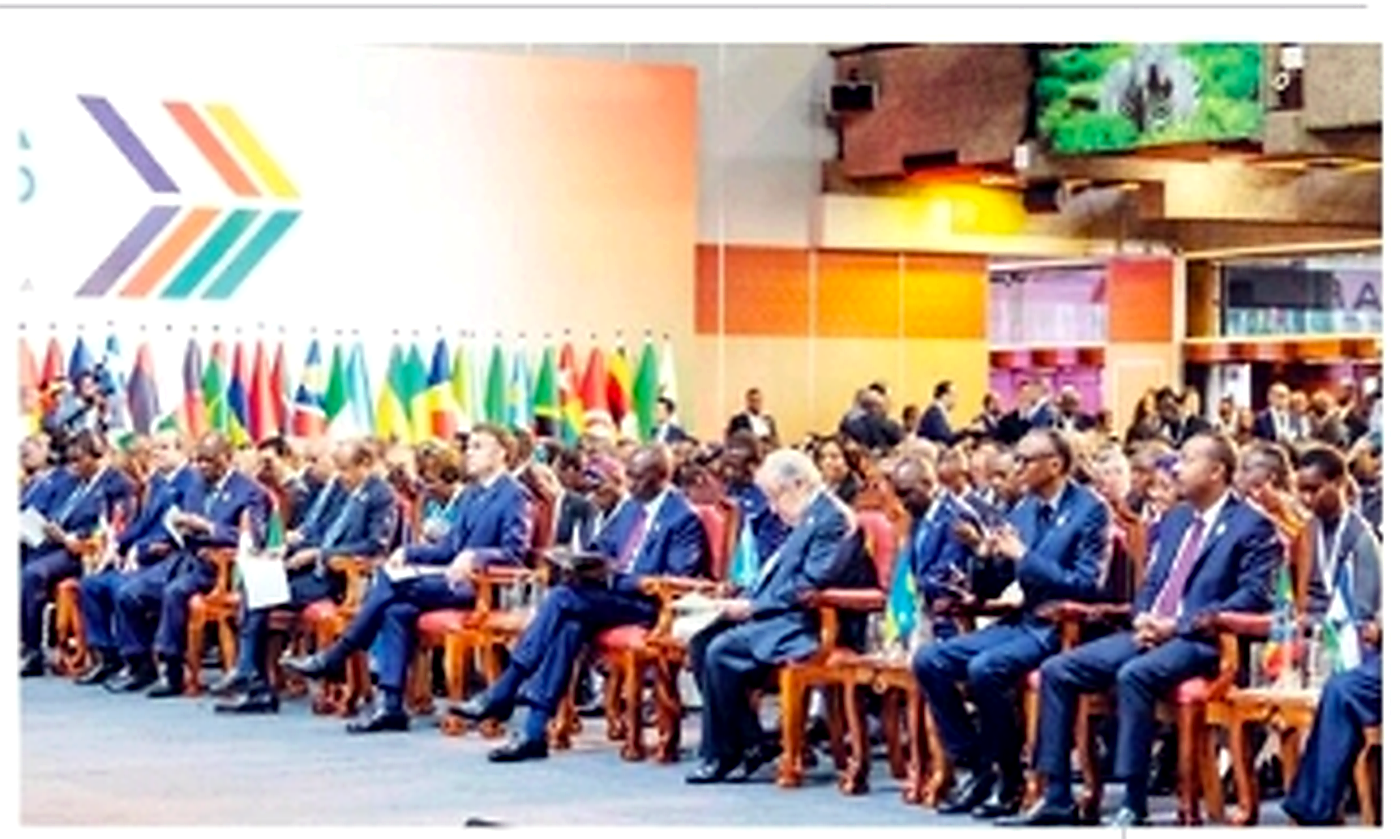
France President Emmanuel Macron arrived in Nairobi for the Africa Forward Summit that was co-hosted by Kenya and France. The summit convened Heads of State, business leaders, and innovators around a deliberately ambitious proposition that stated Africa should be a co-creator of solutions not a passive recipient. Framed around innovation, effective multilateralism, and transformative partnership, the meeting sought to signal a new kind of engagement, one grounded less in hierarchy and patronage, and more in reciprocity, shared problem-solving, and recognition of Africa’s agency.
This summit has traditionally been held, without exception, in Francophone Africa for sixty years. It is a gathering that has historically functioned as a biennial communion of French-speaking African leaders with their former colonial metropole, a forum whose guest list, agenda and symbolism were all calibrated around the architecture of France's traditional continental influence. To hold it anywhere outside that architecture was unthinkable.
Over the five years leading up to this summit, France had been pushed out of Mali, Burkina Faso, and Niger. Its troops were withdrawn, its ambassadors expelled, and in capitals where Paris once sauntered with the easy confidence of a landlord collecting rent, it suddenly found itself unwelcome. This was not just a diplomatic setback. It was a public unravelling of Françafrique, which is the decades-old system through which France maintained political, military, and economic influence over its former colonies.
It was a system now openly, and at times violently, repudiated in parts of the very region it was built to manage.
Kenya is not a former French colony. Kenya does not speak French. Kenya has no historical obligation or debt of loyalty to the Françafrique system. In that sense, this summit represented more than a high-level diplomatic gathering. Kenya’s decision to host and elevate the meeting was therefore not merely ceremonial. It was a strategic assertion and a territorial claim in diplomacy, in convening power, in regional centrality, and in economic imagination.
Today countries do not rise merely by receiving aid. They rise by having the audacity to place themselves at the center of conversations that allocate capital, technology, infrastructure, partnerships, and strategic attention. In geopolitics, as in life, the future rarely belongs to the meek. It belongs to those who know when to convene, when to signal, and when to act as though they belong in the room where the maps are being redrawn. Kenya, in choosing to host and visibly shape this engagement, was doing exactly that.
The deeper logic
The neo-colonial critics have asked Kenya to reject the dinner table, and to wave Sinatra away on the grounds that powerful people historically extract value from interactions with less powerful ones. That is true. It is also true that Swifty did not become one of Hollywood's most powerful agents by avoiding powerful people, but by engaging them. The answer to France's history is not avoidance. It is better contracts, stronger oversight, and the chutzpah to say "not now, Frank" when the moment calls for it.
And Kenya’s moment came when President Ruto stated that Kenya is looking neither East nor West, but forward.
Let’s briefly examine some of the sectors clustered around the engagement. One may debate their scale, feasibility, execution, financing terms, or the implementation probability of each. That is fair. Indeed, it is necessary. But that is not the point.
The point is pattern.
This was not a random basket of diplomatic candy. It was an attempt to place Kenya at the intersection of the architecture of future competitiveness. And it takes a certain chutzpah for an African state, especially one with our domestic frustrations and fiscal pressures, to insist on being seen not merely as a petitioner for aid, but as a platform through which serious partnerships can be organized.
Let’s assess the commuter rail for starters. In our public discourse, transport is often discussed as though it were a matter of roads, matatus, and bodabodas. But urban rail is not merely a transport issue. It is a labour market, housing and productivity issue. A city that cannot move workers efficiently taxes growth every morning and every evening. It punishes labour through time. It punishes firms through unpredictability. It punishes families through exhaustion. So if Kenya wants to signal seriousness about metropolitan growth, then commuter rail is not decorative. It is foundational.
On logistics and port infrastructure, again, this is not just about cranes and containers. Ports are about time, and in economics, time is competitiveness. A country that cannot move goods efficiently cannot industrialize credibly. It becomes a nation that imports ambition and exports delay. To place logistics in the center of a high-level engagement is to signal that Kenya understands that development is not merely about producing things, but about moving them at speed and scale.
On digital infrastructure, digital systems have become a serious anchor of state competence. They affect how a country governs, how it secures data, how it integrates markets, how it attracts firms, and how it disciplines inefficiency. If Kenya misses this, it will not merely lag in innovation but will govern more expensively and become less competitive.
In the age of climate volatility, a country that treats climate services as peripheral and an abstract technical add on is a country condemning its people to live by surprise. Farmers plant not knowing whether the rains will come or fail. Pastoralists move too late and lose herds to drought. Families watch floods wash away their homes and crops with little warning. Power systems swing between drought-driven shortages and costly instability. Climate services are the difference between citizens having time to prepare and being forced repeatedly to absorb avoidable loss.
Kenya is, in effect, saying something larger than the event itself. It is saying that we do not intend to merely watch the next development cycle happen elsewhere. We intend to convene around it, shape parts of it, and claim a seat in it. Swifty's dinner with the starlet was also, technically, "just a dinner." The dinner was not the deliverable. It was the positioning that made the deliverable possible. Likewise, Kenya's summit hosting is the dinner. The financing terms, the concession structures, the technology transfer obligations are the deliverables.
Now let me concede something. Chutzpah can fail. Audacity without discipline becomes delusion. Gall without implementation becomes comedy. A summit can easily become a monument to overstatement if no follow-through emerges. The critics of the summit are right to warn that African states historically have a dangerous addiction to headline economics, forever announcing futures they do not administratively possess.
But that is precisely why the correct criticism should not be, “Why host it?” It should be, “What conversion machinery exists after the hosting?” This is intelligent skepticism. Because hosting is not just about receiving guests, but about manufacturing centrality. It is about telling partners, investors, diplomats, and competitors alike that Nairobi is not merely a stopover city or an NGO capital. It is a political and economic staging ground. Countries compete for that status, even when they pretend not to. The prize is not applause.
The prize is being seen as the place where conversations become projects and projects become ecosystems. Convening power compounds, and a state that repeatedly hosts serious conversations begins to attract serious transactions. Not automatically. Not perfectly. But meaningfully.
The final test
There is also a postcolonial discomfort that shadows any engagement with France or any other European power. Some will instinctively read the entire matter as dependency wrapped in diplomatic language. History justifies caution here. But history should not condemn us to strategic adolescence. Kenya should not prove independence by avoiding consequential partnerships, but by entering them with clarity, extracting value, and refusing to behave like a grateful spectator to its own future.
Finally, my unsolicited advice is to President Ruto. Kenya must not apologize for strategic ambition. It must, however, discipline it. Chutzpah is useful at the door. It gets you into the room. But once inside, only competence keeps you there. The summit was the audacious knock. The agreements are the opening line. What follows must now be the difficult, unglamorous work of execution.
If you are not living on the edge, you are taking up way too much space - Stephen Hunt