
The rider and the elephant
One day, a rider set off on a long journey through forests, hills and valleys. His mode of travel was unusual. He rode an elephant.
For several days, the journey followed a predictable rhythm. The elephant moved steadily along the path, occasionally stopping to feed on the lush vegetation surrounding it. At nightfall, rider and elephant rested. At first light, they resumed the journey.
Then one morning, the elephant refused to move. The rider tried everything he knew. He kicked at its legs, pulled its tail, prodded its enormous sides with a stick and shouted into its ears. He even attempted the absurdity of pushing six tonnes of immovable animal with the strength of one man.
But nothing happened. Eventually, exhausted, the rider sat down. And then another possibility occurred to him. Perhaps the problem was not strength. Perhaps it was method.
He returned to the elephant differently. He stroked its underbelly, rubbed its trunk and hummed softly into its ear. Slowly, the elephant rose, lifted the rider onto its back and continued the journey.
Where the real strength lies
The rider had not become stronger. He had simply understood where the real strength lay.
Behavioural psychologist Johathan Haidt used this image to describe the relationship between reason and emotion. A small rider reasons, plans and weighs consequences. A large elephant feels, wants and holds nearly all the strength. When the two agree, the journey is smooth. When they disagree, the rider is left with two options, to threaten the elephant or coax it.
Politics works remarkably similarly. Politicians strategize. Pollsters calculate. Parties negotiate. But ultimately, the electorate is the elephant.
And the events of the last several days suggest that Kenya's road to 2027 may depend less on who holds the reins than on who understands what will actually make the elephant move.
Memory and the mathematics of unity
On Monday, October 19, Kalonzo Musyoka held a press conference to demand deeper investigations into the organizers, funders and participants of the violence that disrupted the first anniversary commemoration of Raila Odinga. He also invoked Raila's unfinished political journey and honored the young Kenyans who participated in the 2024 anti-Finance Bill protests.
The political architecture is obvious. Kalonzo is working on memory of Raila, the protests, the political violence and citizens who believe the promise of constitutional government remains incomplete.
It is powerful terrain because elections are rarely purely rational exercises because voters carry political memory. A government can present ten pages of economic statistics, but if the citizen's strongest recollection is hardship, indignity or betrayal, statistics may struggle to compete.
Then came Wamunyoro.
A day later former Deputy President Rigathi Gachagua hosted Edwin Sifuna and leaders associated with Linda Mwananchi at his Nyeri residence. He characterized the conversation as one about Kenya's political future where the construction of a united opposition coalition could convert shared dissatisfaction into a single electoral force.
Again, the logic is understandable.
No serious opposition wants to approach a presidential election fragmented against an incumbent. The mathematics of coalition-building therefore demands conversations between leaders who might otherwise have little reason to share a political vehicle.
But there is a paradox. The closer opposition leaders move towards one another, the closer they move towards the question they have so far been able to postpone. Who yields?
Coalition formation is easy while everyone is discussing unity. It becomes considerably more difficult when unity requires someone to surrender a presidential ambition, someone else to accept a subordinate position and regional political entrepreneurs to convince their supporters that another leader should carry their aspirations.
Kalonzo believes his political moment has arrived. Gachagua carries the emotional energy of political rupture with the President he helped elect. Sifuna represents generational impatience, urban opposition politics and an attempt to build a non-ethnic political identity. Others will inevitably enter the equation. A coalition can therefore combine constituencies mathematically while remaining psychologically incoherent.
From macroeconomics to lived experience
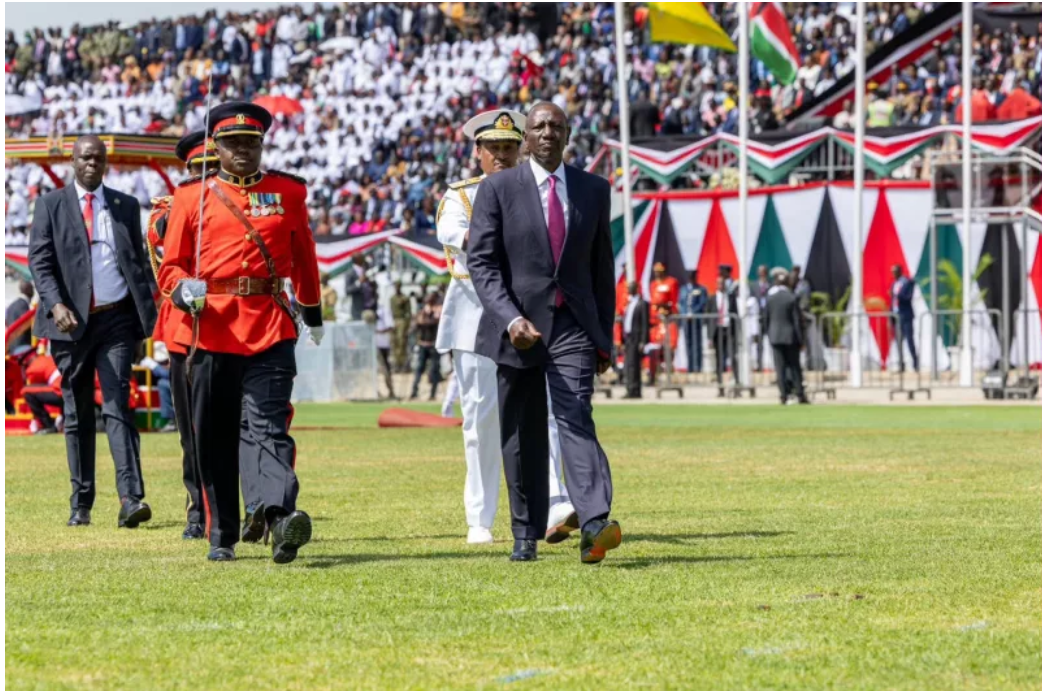
And this is where Mashujaa Day in Eldoret becomes far more interesting than a ceremonial setting.
President William Ruto used the Mashujaa day address to acknowledge explicitly that young Kenyans had protested over taxation, unemployment, the cost of living and the pace of change, adding that an electoral mandate did not silence citizens between elections. He did not pretend that the frustration was absent.
That acknowledgment matters.
For much of his presidency, Ruto's fundamental political difficulty has been a translation problem. The government speaks macroeconomics. Citizens live microeconomics. Government speaks of fiscal consolidation, foreign-exchange stability, agricultural reforms and macroeconomic recovery. Citizens experience bus fare, unga, rent, school fees, medical bills and whether there is money left on the twenty-fifth day of the month.
Those are not necessarily contradictory realities. But politically, the second eventually judges the first.
This is precisely why Ruto's Mashujaa Day proposals deserve analysis beyond their individual fiscal merits.
He proposed exempting workers earning Sh32,333 or less from PAYE, removing stamp duty on land transactions valued at Sh1 million or below, eliminating the 25 per cent import duty on mobile phones and expanding paid internships to 50,000 young people beginning January 2027. The proposals still require the relevant legislative and administrative processes before they take effect.
Each can be argued over economically. But politically, their design is unmistakable. They are not mega projects. They are personal interfaces with the voter’s everyday life. A payslip. A plot of land. A mobile phone. A first job. These are not abstractions. Each removes a cost standing between a household and something it already wanted. Nobody has to be persuaded to want a bigger take-home pay or a first job. They only have to find the way a little easier to walk.
Memory versus expectation
Ruto is working on expectation. That is potentially more significant than another coalition announcement. The opposition's strongest political asset is retrospective where they ask the electorate to remember what happened.
Ruto's strongest possible counterargument is prospective. He is asking the electorate to consider what happens next. This creates a contest between memory and expectation.
The opposition needs to turn accumulated public frustration into a conviction that political change is necessary. Ruto needs enough citizens to believe that whatever pain accompanied the first phase of his administration is beginning to produce sufficient improvement to make continuity worth considering.
Begs the question. Did Ruto’s speech on Mashujaa day mark his move from a reform presidency to a harvest presidency? You be the judge.
And the timing matters. The opposition is in its most complicated stage, which is coalition construction, and that requires leaders to give up ambitions to one another. Ruto is in a different stage, coalition expansion, which lets an incumbent add constituencies without asking existing ones to step aside. That asymmetry is why his strategy may be more formidable than conventional ethnic arithmetic suggests.
A coalition of everyday interests
That is an entirely different election from the one currently being discussed. Most commentary will continue counting ethnic blocs. Running mates will be allocated. Presidential candidates will be imagined. Percentages will be added and subtracted.
But there may be another coalition developing underneath that familiar map. This is the taxpayer who keeps more of a modest salary. The graduate who gets an internship. The farmer who receives a better return. The family that acquires its first asset. The informal trader whose customers have a little more disposable income. The young Kenyan for whom a cheaper smartphone is a workplace, a bank and a market. The beneficiary of affordable housing.
These citizens do not necessarily identify themselves as members of one political constituency. So when enough of these interventions begin to land, the political question subtly changes from has the government disappointed you, to is the direction of travel now improving enough to continue? The first is a referendum on a man, while the second is a calculation about continuity of the landing interventions. That is a much more favorable question for any incumbent emerging from a period of painful economic adjustment.
The opposition has been fighting Ruto's record. Ruto appears increasingly determined to fight on trajectory. The difference is enormous. A record belongs to the past. A trajectory points towards the future. One asks voters to judge. The other asks them to anticipate.
The President therefore benefits from one subtle feature of incumbency where his strategy is to convert the presidency into proof of usefulness. A citizen need not believe that everything is good. She needs only to suspect that changing direction now might interrupt something that is beginning to work.
Therefore, the most consequential outcome of the Mashujaa Day speech may have little to do with the parade. It may be that the 2027 election has quietly begun to change its question, and in politics, the person who defines the question often travels a long way towards determining the answer.
A reason to take the next step
Which brings us back to the rider and the elephant. The rider can study the route, calculate the distance, determine the destination, and hold the reins so firmly that he convinces himself he is in control. His plan was sound, his map was accurate and his argument for moving on was perfectly rational. None of it mattered until the elephant stood up.
While some of the riders this weekend are still deciding who holds the reins, the one in Eldoret went around to the front of the animal and offered it a reason, a personal one, one it could feel, to take the next step.
Making Usawa ni Sawa felt
Finally, my unsolicited advice is to President Ruto. Keep fixing the macro fundamentals, while making Usawa ni Sawa something the elephant can actually feel. And you ably did so on Mashujaa Day where you translated stabilization into lived experience of incomes, jobs, prices, credit, housing, farmer returns and opportunity. This shift is sufficiently personal, and it reinforces the case for continuity.
The rider evolved to serve the elephant - Jonathan Haidt