In the 1930s, the American electric companies had a tidy explanation for why the countryside sat in darkness while the cities blazed with light.
Their explanation was that it was an income problem. They said that the farmers were too poor and too scattered to make electrification worthwhile. They said even if they stringed power lines across all that empty country, many would still be unable to afford the electricity.
They said the solution was to raise farm incomes and electrification would follow of its own accord. At the time, barely one farm in 10 had power, compared with roughly nine urban homes in 10, and the market had looked at the numbers and declined.
Five years later, the Rural Electrification Administration (Rea) was created. It rejected that logic outright. Rea treated the missing grid not simply as a symptom of poverty, but as a structural failure that only the state could remedy.
Through cooperatives and federal loans, it strung power lines out to the farms, and what followed rearranged the argument. Electricity was used to milk the cows, warm the chicks, power farm equipment.
Shortly after, other electric household appliances made their way into the homes. Resultantly, productivity rest, and incomes improved, and within a generation, nearly every farm had power.
True, income had mattered all along. But the missing infrastructure that made higher incomes possible mattered too. There is no amount of waiting for farmers to become richer that would have laid a single mile of the power line.
Once the infrastructure arrived, it lowered the cost of production, saved time, expanded output and created entirely new uses for labour and capital. To put it simply, electrification did not merely serve prosperity after it appeared, it helped produce it.
The wallet and the slum
Ninety years later, the Nairobi Senator Edwin Sifuna has offered much the same tidy explanation which gave it the seductive geometry of a good aphorism. Slums, he argued, are not a housing problem, but an income problem. Raise incomes, and the informal settlements will sort themselves out.
Rather than impose a mandatory housing levy, government should put more money in people’s pockets and allow citizens to climb the housing ladder on their own. In other words, empower the household and the household will house itself.
His reasoning was neither careless nor unkind. It was simply incomplete. His argument has the superficial clarity of a clean diagnosis, but it also contains a strategic evasion.
This is an elegant argument. But it is also wrong at the joint.
Sifuna is entirely right, that income matters. No serious person disputes this. A family earning Sh5,000 a month has radically different housing choices from one earning Sh60,000.
Higher and more stable earnings expand the range of housing people can afford, reduce the desperation that fuels overcrowding and strengthens the tenant’s bargaining power.
The problem is therefore not what Sifuna puts into his argument. It is what he quietly discards. To call the slum an income and not a housing problem, is to smuggle in a subtraction, which is the little but significant word ‘not’.
Because this small word converts a relationship between two problems into a choice between them. It asks us to believe that once the wallet has been repaired, the house will repair itself.
Consider the simplest possible test.
Suppose every household in the slums doubled its income by the end of this year. Would we have as many serviced plots? As many sewer lines? Would access roads widen, and new water mains appear? Would the supply of formal houses suddenly double?
The residents would be richer, but the housing system around them would remain exactly as constrained.
And here economics becomes particularly inconvenient for the income-only argument. When the purchasing power of buyers rises but the supply of what they are buying does not, prices respond.
If 10 families are competing for five decent houses, doubling the incomes of all 10 families does not create another five houses. It gives 10 families more money with which to bid for the same five. Some of the income gain will therefore be captured in higher rents and land prices.
In economic-speak this underlying problem is called inelastic supply. Demand can rise quickly, but the supply of serviced land and housing cannot respond at the same speed. A house requires land, planning approval, roads, drainage, water, sewerage, electricity, finance and construction.
Several of those things cannot be summoned into existence by an individual household, however industrious its members become.
Consider what a slum actually is. UN Habitat does not classify a settlement as a slum on the basis of its residents’ wages. It looks instead at deprivations in the dwellings and its surroundings such as durable housing, sufficient living space, access to safe and affordable water, adequate sanitation and security of tenure.
That distinction matters. A man may triple his income overnight and still have no secure claim to the ground beneath his dwelling.
He may still queue for water from the bowser because the pipes were never laid, still share a pit latrine because no sewer exists, still watch rainwater flow through his doorway for lack of drainage and still wake each morning unsure whether a bulldozer will arrive before dawn.
Higher income may improve choices, but it cannot manufacture the public infrastructure on which those choices depend. This is the error at the heart of the income argument. It treats conditions created by collective failure as though they were merely the private consequences of an inadequate payslip.
Raise every resident's income and you have created richer residents. But unless housing supply also expands, tenure becomes more secure and infrastructure follows, you will still have richer people competing for the same inadequate houses and infrastructure. You will have addressed the wallet and left the slum.
The arithmetic of density
There’s another reason this matters. Take Funyula for instance. The argument advanced by Sifuna is to ask why government is building affordable housing there where people have ancestral land, keep livestock and can construct their own housing.
This argument assumes that rural housing and urban housing solve the same problem in the same way.
They do not.
Indeed, one of the quietest pressures on rural Kenya is precisely the endless subdivision of land. Every generation divides what the previous generation inherited until an agricultural asset becomes a residential plot with a maize stalk standing apologetically behind the kitchen.
If every son must solve his housing problem by carving another piece from the family farm, it shackles the next generation to a shrinking asset precisely as it is handed to them, and then what looks like a housing solution today becomes an agricultural problem tomorrow.
Economists call this fragmentation below the viable holding. This is the point at which a parcel is too small to be culturally and economically viable because small, fragmented plots are harder to mechanise, to irrigate efficiently and more expensive to farm per acre. They also trap capital in land that is neither fully agricultural nor fully urban.
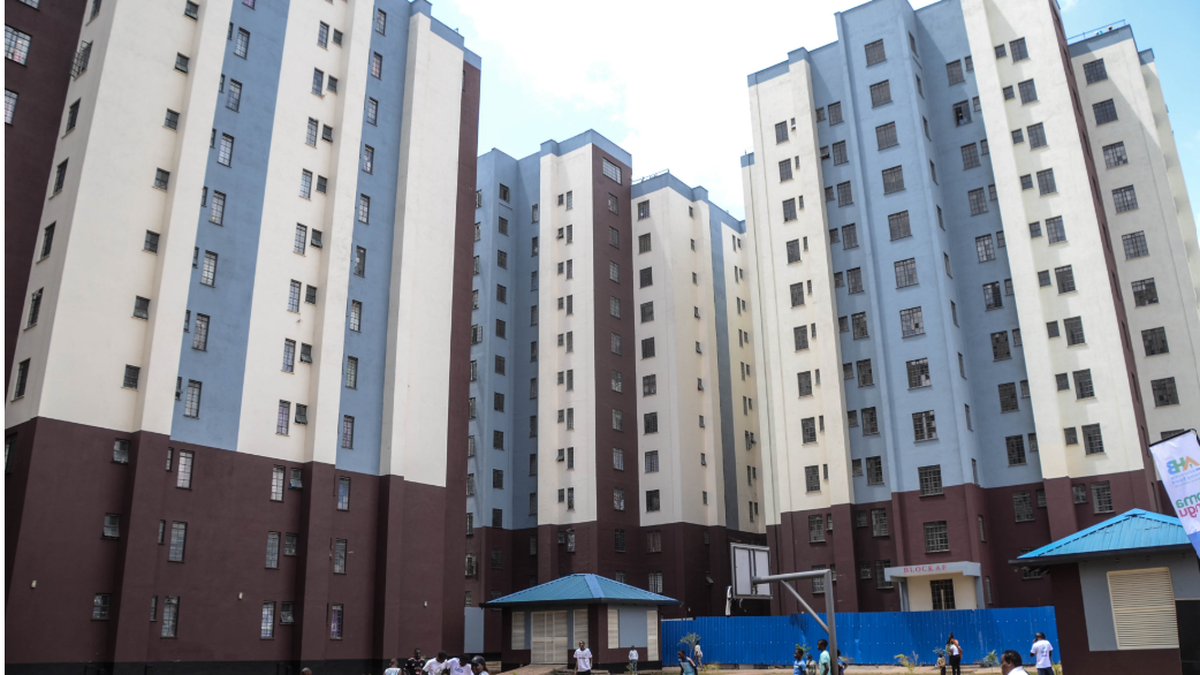
Which is where the case for building upward stops being about architectural design and starts being about arithmetic. When the state builds a cluster of decent housing around a market centre, it is not merely providing walls and roofs.
It is inducing concentrated demand for shops, transport, food, childcare, maintenance and entertainment, the entire small economy that cannot survive where households are scattered kilometres apart.
A shopkeeper who once depended on a thin trickle of customers now has hundreds within walking distance. A boda boda rider makes more trips over shorter distances.
A food vendor has a reliable lunch crowd. Small business enterprises become viable because there are finally enough people nearby to sustain them every day.
What looked like a housing project begins to function as a market. And none of these business enterprises will have been built by the state. The state only enables the proximity that turns several subsistence households into hundreds of daily transactions.
It also makes it cheaper by orders of magnitude, to extend water, sewerage, electricity and roads infrastructure. A pipe that serves 50 families in a block is a public investment, while the same pipe chasing 50 homesteads across hills is a public impossibility.
Density is not the absence of space. It is the presence of everything that space, thinly spread, can never afford for example the transformer that needs enough meters to warrant the line. And the vertical housing returns agricultural land to the work land is for.
Infrastructure before prosperity
Finally, my unsolicited advice is to Sifuna. This is precisely what rural electrification did for the American farmer. The power line did not arrive after the farmer improved his income. The power helped him become more productive, and therefore richer.
The same logic applies in Funyula and slums elsewhere. Like the powerline in America, the housing programme can become part of the machinery through which increased income is created.
The lesson from electrification was never that poverty did not matter. It was that waiting for poor people to become rich before building the infrastructure that could make them richer had the logic exactly backwards.
Therefore, to treat the housing programme as a temporary imposition on today’s preferences is to misunderstand the time horizon of nation-building. The state that only builds for the present leaves the future poorer than it needs to be.
Denser communities do not crowd out life; they conserve the land that feeds it and make affordable the networks that sustain it. — Jane Jacobs, The Death and Life of Great American Cities