Restoring the invisible infrastructure
When Franklin D. Roosevelt took office on March 4, 1933, the United States banking system stood on the brink of total collapse. Months of unchecked panic had triggered massive bank runs across the nation, compounding a crisis that had already seen over 4,000 banks fail since 1929 and leaving public trust in the financial system completely shattered.
Recognizing the urgency of the moment, FDR acted just thirty-six hours into his presidency. On March 6, he declared a nationwide Bank Holiday, temporarily shutting down every bank in the country to stem the panic. In the quiet pause that followed, Congress passed the Emergency Banking Act, granting the Treasury authority to inspect institutional balance sheets and ensure that only verifiably solvent banks would be permitted to reopen their doors.
Yet reopening the doors was only half the battle. The government still had to restore the public's faith. On the evening of Sunday, March 12, Roosevelt delivered his first-ever fireside chat via nationwide radio. Speaking in calm, accessible language, he explained the mechanics of fractional-reserve banking, demystifying why institutions could not hold every deposit in physical cash, while detailing the rigorous audit process and assuring citizens that the audited banks were once again safe.
The response was immediate and extraordinary. When banks reopened on Monday, March 13, long lines formed outside their doors. Not to demand cash back, but to return it. Within weeks, Americans poured over USD 1 billion in currency and gold back into the vaults, bringing an end to the banking panics of the Great Depression.
This historical event contains a lesson that we repeatedly forget. Systems do not function merely because their architecture is sound. They function because a critical mass of people believe the architecture will hold. Consequently, trust becomes the invisible infrastructure beneath the visible one.
What Nairobi brought to the table
And this is precisely why the just concluded Trust Summit in Nairobi deserves more serious consideration than the regular diplomatic conference treatment of speeches, photographs and communiqués.
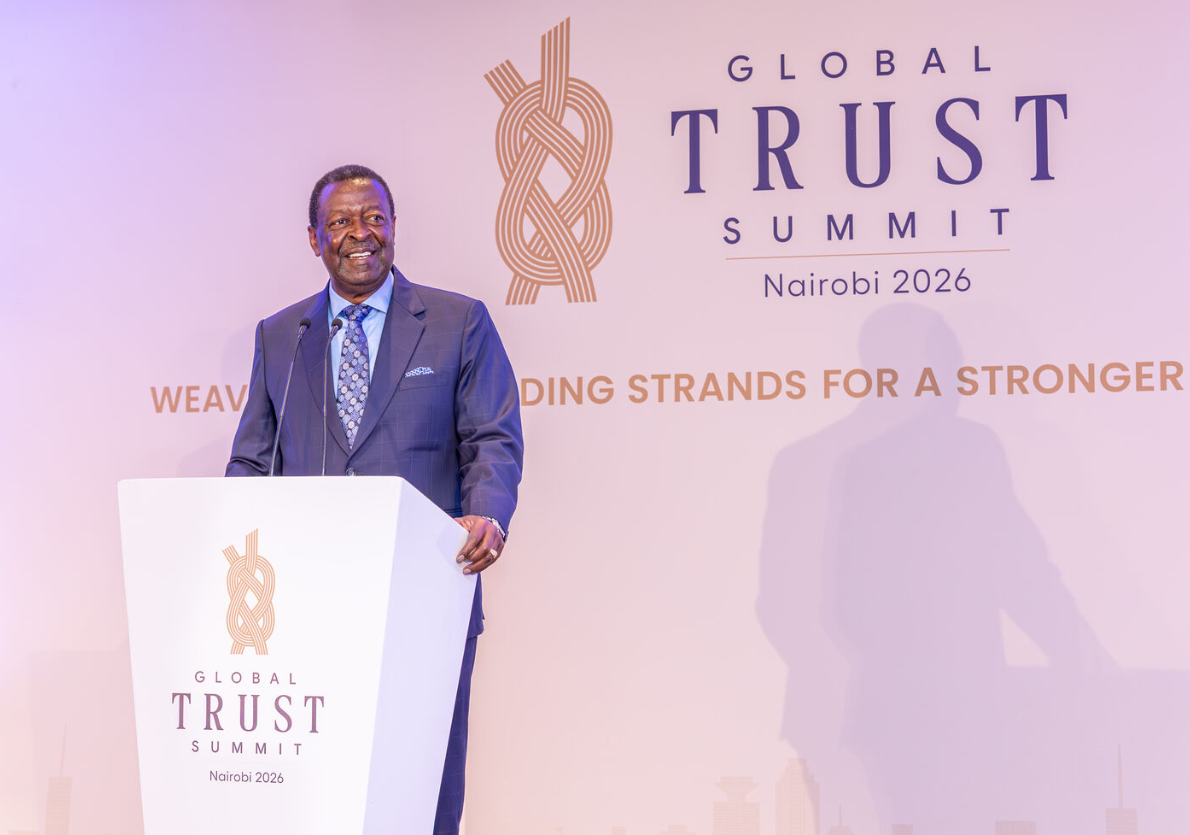
The Summit which was held from October 21 to 23 under the theme Weaving Trust: Binding Strands for a Stronger Global Order, brought together governments, international organizations, regulators, businesses, civil society, academia, media, technology actors and the youth. It ended on a high note with the Nairobi Declaration on Trust and a 29-point Call to Action, together with proposals for a Coalition on Global Trust, a Nairobi Trust Council, a Global Trust Facility and a Framework for Action.
These were the visible outputs. The more interesting outcome is conceptual.
What Nairobi did was to move trust from the soft edges of governance into its hard center.
Trust must be earned
For years, trust has been discussed as though it were primarily a communications problem. When citizens distrust government, communicate better. When investors are nervous, improve messaging. When people distrust institutions, explain them more carefully.
Begs the question. Is mistrust cured by louder explanations?
People generally distrust institutions because of something they have experienced, observed or inferred. An unfulfilled promise, unequal treatment, opaque decision-making, corruption, misinformation, institutional failure or the belief that the rules are applied selectively.
This underscores one of the most important ideas coming out of the Summit that trust must be earned through conduct, rather than demanded through authority.
The Prime Cabinet Secretary Hon Musalia Mudavadi captured this point neatly when he argued that institutions cannot simply demand belief. They must practice the honesty, fairness and accountability from which trust grows.
The invisible tax
But there is an even more consequential dimension. Trust has an economic price.
Consider two identical countries seeking investment. Both have the same infrastructure. Both possess similar labor. Both offer comparable tax incentives. In one, contracts are regarded as reliable, regulations are predictable, and official commitments are durable. In the other, investors believe regulations may change without warning, information cannot be relied upon, and political assurances expire with political convenience.
Capital prices those countries differently. The difference is trust. And just like that, trust becomes an invisible tax.
It lengthens due diligence, raises insurance costs, increases required returns, encourages capital to remain liquid rather than committed, makes businesses hold larger buffers, makes governments spend more enforcing what cooperation might otherwise achieve involuntarily, and wastes one’s time deciding whether a news item is real or not. Each payment works like an excise duty on every transaction, collected by nobody, and spent on nothing.
Credibility begins at home
Seen from that angle, hosting the Trust Summit was not an eccentric diversion for Kenya’s Ministry of Foreign Affairs. This was classic economic diplomacy. And this is where the leadership taken by PS Sing’oei deserves closer examination.
Months before delegates assembled in Nairobi, the State Department for Foreign Affairs had began bringing regulations, and other institutions into the discussion. In June, the Ministry convened representatives of 20 regulatory institutions to examine how their conduct affects confidence, institutional legitimacy and Kenya’s standing as a trusted international partner. The PS argued then that trust increasingly influences diplomacy, investment, trade, multilateral cooperation and development.
That framing matters because foreign ministries traditionally manage relations between states.
Sing’oei’s approach reflects a wider understanding of contemporary diplomacy that what happens inside states increasingly determines their leverage between states. This means that a country’s reputation does not begin at an Embassy. It begins at home.
An investor encountering an unpredictable regulator carries that experience into his assessment of the country. A citizen who considers public institutions opaque contributes to the country’s broader reputational environment. An election perceived as transparent, strengthens both domestic legitimacy and international confidence. Domestic credibility therefore increases foreign policy capital.
From trust maintenance to trust engineering
The same logic extends beyond Kenya where the international system itself is suffering from a trust problem. Developing countries are routinely asked to trust institutions in which their representation remains limited. Moreso African governments are asked to defend multilateralism while questioning whether multilateral institutions adequately represent contemporary economic and geopolitical realities.
As for citizens, they are asked to trust information ecosystems that are increasingly penetrated by artificial intelligence, disinformation, and algorithmic manipulation. And countries are asked to cooperate on climate change, pandemics, and security, while geopolitical competition rewards suspicion.
Trust cannot therefore simply mean asking people or countries to have greater faith in existing arrangements. Sometimes the arrangements themselves require redesign. Hence Sing’oei’s proposal that states consider using Article 109 of the United Nations Charter to convene a diplomatic conference to examine the contemporary relevance of the international institutional architecture deserves consideration.
Whether such a conference will materialize is a secondary issue. The intellectual point made however, is a sophisticated diplomatic proposition because it initiates the conversation on the distinction between trust maintenance and trust engineering.
Nairobi as a laboratory for trust
Nairobi was brave. It chose to host the more difficult conversation. A country doesn’t qualify to host a trust summit because it has resolved all the mistrust. Quite the opposite. Countries where public trust is contested may have more to teach us about rebuilding it than societies that assume the problem has already been solved.
Kenya brings to the discussion table democratic contestation, an assertive citizenry, a vibrant digital public sphere and a political culture in which citizens interrogate government tirelessly. This made Nairobi the laboratory for understanding the reconstruction of trust. And what emerged was that there is no single trust deficit. A citizen can trust her neighbor but distrust Parliament. An investor can trust the central bank but distrust a regulator. A young person can distrust government while trusting a digital community.
Treating all these as one phenomenon produces bad policy because you cannot fix all mistrust with the same intervention. This is why the proposed Trust Council could give Kenya something larger than another international secretariat. It gives it custodianship of an emerging global policy conversation.
Allow me to explain. Cities acquire diplomatic identities gradually. Geneva became associated with humanitarian diplomacy and multilateralism. The Hague with international justice. Davos with the conversation between business and global political leadership.
Likewise, on the heels of this Trust Summit, Nairobi should occupy the space on trust diplomacy through the science and practice of rebuilding institutional confidence. And the Trust Summit identified something that is often treated as intangible and placed it squarely inside foreign policy. Not trust as politeness, but as diplomatic capital. Not trust as government popularity, but as institutional legitimacy. Not trust as communication, but as economic infrastructure.
When the visible infrastructure works again
Which takes us back to Roosevelt’s America. When the banks reopened in March 1933, the steel vaults were essentially the same vaults. The buildings didn’t transform overnight. Money had not magically multiplied. What changed was the public’s willingness to place its money back inside the system. And resultantly, the visible infrastructure began functioning again because the invisible infrastructure had been partially restored.
Nairobi’s Trust Summit made a similar contribution on a much larger canvas when it asked the world to stop treating the absence of trust as an attitude problem among citizens, and start treating it as an institutional problem requiring design, investment and repair.
From hosting the conversation to owning the methodology
Finally, my unsolicited advice is to PS Sing’oei. Do not allow trust to become another conference vocabulary that sounds profound in Nairobi and disappears in implementation. The real opportunity is to turn the Summit into a Kenyan diplomatic asset. Build the Nairobi Trust Council into a working platform, develop measurable trust indicators, test them with regulators and public institutions, convene annual reviews, and make Kenya the place where governments, investors and institutions come not merely to discuss trust, but to learn how to rebuild it. If Nairobi can move from hosting the conversation to owning the methodology, then this Summit will have achieved something far more important than a declaration. It will have given Kenya a new form of diplomatic capital.
The best way to find out if you can trust somebody is to trust them - Ernest Hemingway