Before the 1840s, time was a local affair in Great Britain. Every town kept its own clock by the sun, and noon in one town was not noon in the next. Then came the trains. In November 1840, the Great Western Railway became the first to mandate London time across its network, and by 1847, the Railway Clearing House declared that Greenwich Mean Time (GMT) must be adopted by all rail companies across Great Britain.
In doing so, these corporations did something no king had managed. They abolished local time, imposed one standardized railway time, printed it in a timetable, and enforced it from above decades before the British government formally codified it into law via the Definition of Time Act of 1880.
It was, arguably, the first moment ordinary life was made to bow to a schedule it had not set. A passenger, once aboard a moving train, surrendered everything to that timetable including the route, speed, stops, the other travelers, and the hour he will arrive.
The public story
However, the Victorians understood the helplessness of a sealed carriage at speed, particularly after a wave of public panic peaked following a brutal railway murder in 1864. Consequently, Parliament passed the Regulation of Railways Act of 1868, legally mandating that trains be fitted with a communication cord, which was a chain any passenger could pull to halt the train in an emergency. They also punished its misuse severely with a hefty statutory fine, because the power to stop the train is the one power that, in the wrong hands, brings the whole timetable down.
The Kenyan boarding school is a train of exactly this kind. It runs to a punishing timetable, whose stops are fixed in advance, whose schoolmates the student doesn’t choose, and whose speed is non-negotiable.
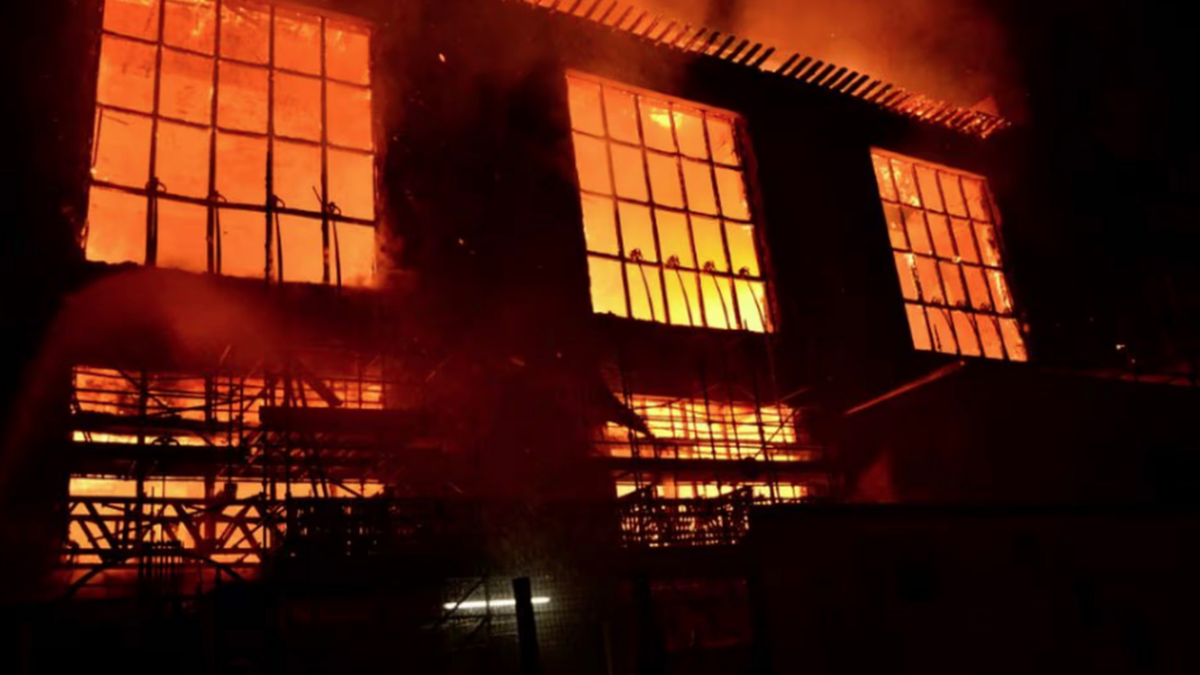
Kenya is again staring at a fresh wave of school unrest and the familiar public performance of shock. Several secondary schools have reportedly been closed, while we are still processing the horror of the Utumishi Girls Academy fire, where 16 students died and many others were injured.
Like the Victorian railway cord, the arson wave has become the chain that students are pulling to halt the train when they believe that no other signal will be heard.
But this is where the national conversation often becomes lazy. We blame the students, school administration, parents, homosexuality, social media, the Ministry and fear of exams. However, school unrest is not new in Kenya. We have had tragedies before, including Bombolulu, Kyanguli, Moi Nairobi Girls and Hillside Endarasha that collectively killed 124 learners. The current wave has only reopened a wound that was never properly healed.
Begs the question. Why?
Not why did a student light a match. That is a criminal and investigative question, and it must be handled within due process. The better question is why students think that destruction is the only language they will be heard.
The Canadian-American sociologist Erving Goffman coined the theory of the total institution, a place where a large batch of like situated people, cut off from the wider world, lead an enclosed, formally administered round of life. Goffman performed covert ethnographic research at St. Elizabeths Hospital in Washington, D.C., a massive federal mental institution with over 7,000 patients. His conclusion was whether it was a mental hospital, a state prison, a military boot camp, or a cloistered monastery, they all operated using the exact same structural blueprint. They were all total institutions where the barriers normally separating sleep, play, and work were nonexistent.
Goffman called this batch living where every phase of the day was spent in the same company, everyone treated alike, to a tight schedule, under formal rules with little or no free time, and with minimal variety or respite, and under an authoritarian plan.
That tight schedule is the timetable. The premium asset of the education system is time, and the system owns all of it. The system is obsessed with unbroken momentum where the syllabus must be covered, the exam calendar must hold, and the timetable must be obeyed.
Every Kenyan who has passed through boarding school knows this starting with the bell, parade, class, prep, lights out, inspection, punishment, exam, repeat. Now let us repeat the quiet part loudly. Our boarding schools are a soft total institution. Students wake up when a bell rings, eat, sleep, study when told, and speak when allowed. Even silence is supervised. Days are measured by bells.
This is the tyranny of the timetable.
It is not that time is unimportant. Learning requires order. Teachers and students require structure. Examinations need calendars, and parents and guardians need predictability.
But the problem begins when the timetable becomes sacred more than the student. When the system cannot pause because the syllabus must move, when distress is treated as disruption, and exhaustion as weakness, and when grievance is treated as indiscipline, then the institution loses moral proportion. The bell becomes louder than the voice, the calendar becomes more important than the learner’s condition, and the system keeps moving even when the learners are exhausted.
For some students, this structure is protective. It creates order, discipline, safety and academic focus. For others, especially adolescents already carrying fear, anger, family pressure, poverty, bullying, grief, exam anxiety or humiliation, the same structure can become suffocating. This is the context in which we must understand the current wave of school unrest.
In a total institution, unrest is rarely just about the visible trigger which may include diet, a cancelled event, examinations, or a confiscated phone. But the deeper cause is usually accumulated pressure from holding students for too long with too few emotional safety valves, at a volatile stage of human development where they are navigating identity, friendship, recognition, family expectations, and fear of failure. Yet the system still treats them mainly as examination units in uniform.
Batch living just doesn’t regulate behavior but also rearranges the inner self. Outside the system, the student has many roles, while inside the total institution she is compressed into one role, performed under surveillance. That is role dispossession which leads to emotional compression. Inadvertently, the system antagonizes that very task of adolescence, consequently producing a kind of institutional claustrophobia where students begin to experience life as a conveyor belt. The self soon becomes compressed into the timetable. It shrinks agency and where there is no trusted outlet, the need for agency can mutate into destruction.
I concede that we cannot have perfect institutions, but we can make them less total. What we need is participatory agency, which is a system where students must have voice, space and influence, while the system must have hearing, responsiveness and the humility to adjust before crisis becomes the only language left..
Voice comes first. Many students are not voiceless because they have nothing to say, but because they are voice-poor from lack of a safe and legitimate way to identify what is wrong, frame it properly and articulate it without being immediately marked as troublesome. In many schools, complaints exist only as whispers in dormitories, coded jokes in classrooms, or resentment during prep.
Then comes space. A student may have voice, but no place to put it. A school that only allows students to speak during crisis has already failed. Space means there are formal and informal places where students can raise issues before they become fires.
Next is influence. If students speak and nothing changes, their participation becomes theatre. Influence does not mean students get everything they demand. It means their voice can cause a pain point to be acknowledged and acted on. Influence is what teaches students that lawful voice can work.
However, it is not enough for students to have voice, if the institution has no hearing. Many schools have de jure hearing including student councils, guidance and counselling offices, boards of management, and policies that exist on paper. The harder question is whether they are trusted in practice.
De facto hearing is different. It is what happens when a student exercises voice. Does anyone listen before resentment hardens? Is the murmur heard before it becomes a fire?
I submit that we must be innovative in creating space. Similar to workspaces, the system should institute an external independent ombudsman that bypasses the school hierarchy entirely. The normal complaint channel often runs through the very people who control the bell and the timetable. This reduces trust. The ombudsman with proper safeguards would triage complaints by urgency, protect students from retaliation, distinguish between genuine risk and malicious reporting, and require documented follow-up. Anonymous complaints would trigger inquiry, and patterns should matter. One complaint may be noise, but several similar complaints are intelligence. An ombudsman would become an insurance against institutional blindness.
The final test
This is how we make schools less total. Not by removing order, but by making order answerable. Not by abolishing the timetable, but by allowing lawful unscheduled interruptions into it. Not by weakening the system, but by improving their hearing, even if the answer is not always yes.
Finally, my unsolicited advice is to the system. Authority in a total institution cannot rest on fear. Fear produces obedience until it produces revolt. Students can accept rules and a timetable. What they reject is a timetable that behaves like a tyrant. A humane system must be willing to slow its own train, to grant the unscheduled stop, and to admit that flexibility is not weakness. The train must run, yes, but no timetable should be so sacred that the passengers feel they must burn the carriage to stop it.
Those who make peaceful revolution impossible will make violent revolution inevitable - John F. Kennedy