Picture a great market at dawn, and two traders arriving with the same basket of fruit. The first trader is well known. He wears a good suit, speaks with ease, and comes from a town whose name inspires trust. His basket is glanced at, weighed quickly, and sold at a fair price.
The second carries fruit of the same quality, sometimes fresher and sweeter. But he comes from a village people had learned to describe before they had learned to understand. So they ask more questions. They inspect his basket twice. They discount him. They warn buyers that perhaps the road from his village is unsafe, perhaps his scales are off, perhaps next season's harvest will fail.
In 1873 a slight, asthmatic Englishman named Walter Bagehot explained the City of London to itself, and produced the finest book ever written about money called Lombard Street. Bagehot’s central insight was almost theological. He posited that the entire towering apparatus of Victorian finance, bills, bonds, and discount houses, that moved fortunes before breakfast, rested not on gold but on one fragile intangible thing: confidence. This instinctively led to credit, or credere in Latin.
Credere means to believe, trust, or place one’s heart. It meant entrusting someone with something valuable, so if you entrusted money to someone, you were extending trust.
Bagehot understood this and explained that belief cannot be argued into being. It is either earned or is guaranteed by someone the world already trusts. A loan is extended on the belief that the lender will be repaid; an interest rate is the price a lender puts on his doubt; and the deepest law of the trade is a paradox: that the man who must prove he is worthy of credit has, in the very act of proving, already begun to lose it.
In this sense, the tragedy of the second trader was not that his fruit was bad. It is that he was priced before he was seen.
The public story
This is the story of Kenya and Africa at large in the global economy.
For many years, the continent has not only suffered from the shortage of capital, infrastructure, technology and fair trade, but from something more intangible and highly expensive. It has suffered from the price of perception.
An investor looks at a project in Africa and immediately adds a risk premium. A lender looks at an African sovereign and prices uncertainty into the loan. A rating agency looks at an African economy and often sees fragility before it sees growth. A global company looks at African minerals and too often wants extraction without value addition. The result is that before the first road is built, before the first factory opens, or even before the first job is created, Africa has already been charged an invisible tax.
That tax is called risk.
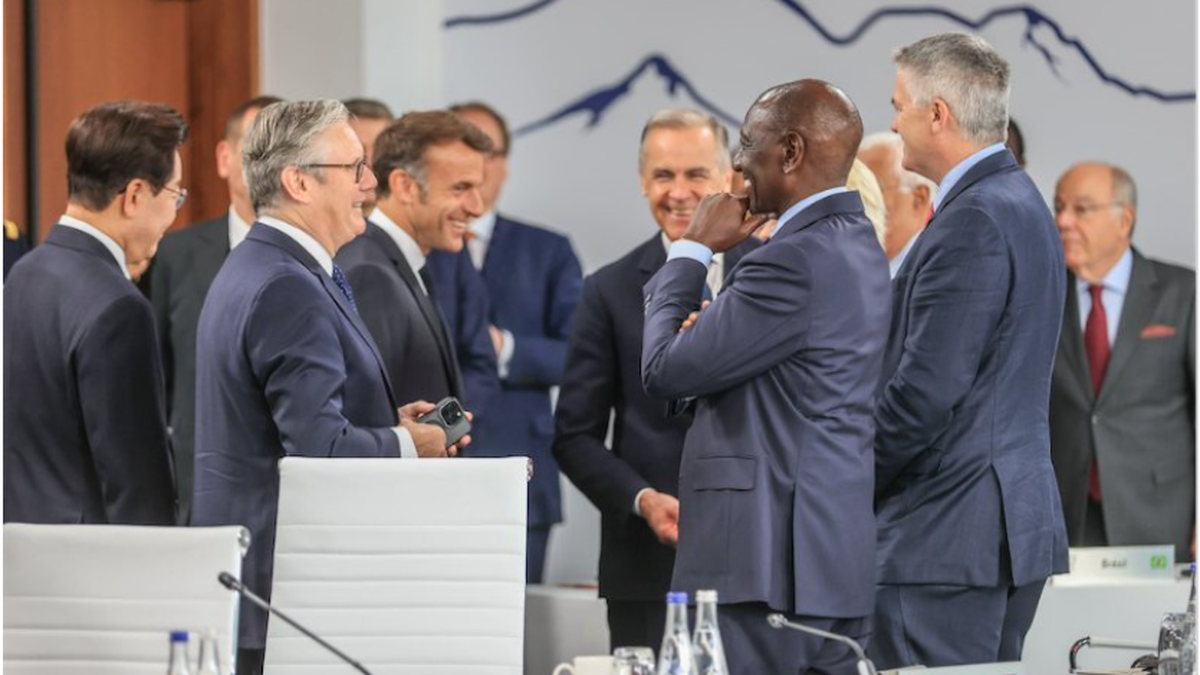
Hence why the conversation about President Ruto’s presence at the recently held G7 Summit in Évian, France must not be reduced to the photos, handshakes, motorcades, or whether or not he was the first Kenyan president to be invited. It should be understood as a fight over this hidden tax. He was not merely saying that Africa needs investment. He was restating that Africa needs a financial architecture that stops punishing it for being African.
However, the reflex in our commentariat is to dismiss every presidential journey as tourism billed to the taxpayer. President Ruto sat as the only African leader at the table of the G7. He did not beg for money. He argued for belief. His thesis, placed across three working sessions, was that Africa is a victim of vast mispricing. He called it a capital injustice whereby the continent is charged ruinous interest, not because its fundamentals are poor, but because the world’s risk models still squint at it through Victorian eyes.
The President’s seat at this table was itself a line of credit, telling the world to extend to Kenya a measure of belief. And the architecture that he pressed for was the Africa Trade and Investment Development Insurance (ATIDI) and the Multilateral Investment Guarantee Agency (MIGA), blended finance, and instruments for debt transparency and risk sharing. He stressed that a guarantee, though not money, is confidence. This may be the most Bagehotian sentence ever spoken by a Kenyan or African head of state. And he was right.
The G7 nations face shrinking or flatlining budgets for traditional Official Development Assistance (ODA). So at the G7, they championed — alongside Kenya as a partner country — a move towards an investment and guarantee model designed to de-risk and mobilize private capital for emerging markets, particularly across Africa. This endorsement formalizes ATIDI as a primary vehicle for turning perceived un-investable projects into secure, bankable options for international financiers.
To back this G7 push, regional and non-regional partners are actively reinforcing ATIDI’s balance sheet, with the African Development Bank approving a $125 million equity investment into ATIDI to expand its capacity to support the continent's new economic corridors.
Likewise, MIGA is the political risk insurance arm of the World Bank Group, and the G7 leaders welcomed the joint work of the World Bank and AfDB to scale up MIGA’s guarantee instruments. So, for instance, if an international commercial bank wants to fund a major renewable energy project but is blocked by strict internal country-risk ceilings, MIGA can issue a non-commercial risk guarantee. And if the government breaches its contract, MIGA covers the losses.
In practical terms, these endorsements allow a pension fund in Frankfurt to lend to a geothermal plant in Naivasha at a rate that reflects the project, not the area code. The ultimate challenge for modern development finance is no longer finding external funding, but successfully de-risking and channelling these immense reservoirs of domestic savings out of passive government securities and into productive, high-throughput regional infrastructure.
Bringing this closer home, the continent sits on a massive four trillion dollars of its own domestic capital, driven by rapidly growing pension funds, insurance savings, and sovereign wealth portfolios, waiting only for an architecture brave enough to mobilize it.
Begs the question: Will Ruto be that architect?
For too long, Africa has been invited into global rooms as a problem. Climate change victim. Debt victim. Conflict victim. Poverty victim. Migration source. Disease risk. Humanitarian burden. The language used may be polite, but the posture is demeaning. It invites sympathy, but sympathy is not power.
We also speak of capital as if it flows wherever opportunity exists. Actually, it does not. Money flows through credit agencies, guarantee mechanisms, insurance, and legal protection. The richer world spent decades laying its own.
At Évian, the President presented a different argument. Kenya and Africa are not asking to be pitied. We are asking not to be discounted. And this is the quiet shift in Ruto's diplomacy, where the old posture asked for aid, but the new one asks for financial instruments. This is precisely the same argument that the recently read budget made, where Treasury declared the era of building every road on a sovereign loan was over and instead turned to private capital through public-private partnerships. Évian and our budget are not two separate events. They are one strategy: to stop financing the country on the State’s overpriced credit card and start financing it on guaranteed private capital that does not crowd out the Gikomba hawker.
This distinction matters.
At Évian, President Ruto told the world to pay attention to Africa because the future of global growth will be shaped here. There is no question that the world is redesigning supply chains and searching for critical minerals. But to benefit, Kenya and by extension Africa cannot arrive as a supplicant. We are a country and continent of young people, minerals, markets, arable land, renewable energy potential, entrepreneurs and digital adoption. We cannot forever be described through the vocabulary of lack. In essence, what he presented was a correction: Africa is not expensive because it lacks value; it is expensive because the world has mispriced it.
Because for decades the continent's mineral story has been one where Africa digs, others process; Africa exports weight while others export value. So when Kenya speaks of critical minerals and insists on domestic processing, it is contesting an old arrangement. The task is not to move minerals out of the ground but rather to move Kenyans up the value chain. And Kenya's advantage is certainly not about the size of our reserves. It is definitely about our stability, ports, legal confidence, green power and connectivity that can enable us to become a node in the supply chain rather than a mine. A mine can be exhausted, but a node continues to accumulate relevance.
The final test
Do we have problems? Absolutely. And major ones at that. Corruption, insecurity, poor governance, weak implementation and enforcement, policy unpredictability, and debt pressures are real.
So I concede that we should not romanticize ourselves. But neither should we permit the world to confuse our problems with our total identity.
Finally, my unsolicited advice is to President Ruto: bank this. A summit photograph is a souvenir, but a signed guarantee facility is an asset. ATIDI has just been recapitalized for precisely this purpose. So the capacity now exists. What is now missing is the deal. Convert access into investment, minerals into factories, guarantees into cheaper capital, and do so with unfashionable speed, anchoring a concrete instrument that outlives the news cycle.
Every banker knows that if he has to prove that he is worthy of credit, however good may be his arguments, in fact his credit is gone. — Walter Bagehot