
In medieval England, sheep covered the landscape, yet a significant portion of the wealth generated by English fleece was realized across the English Channel. Flemish towns had accumulated looms, dyers, craftsmen, merchant networks and commercial intelligence required to turn English wool into higher-value cloth. England possessed the strategic raw material that other economies had organized much of the industry around.
England eventually changed its position because it realized that possessing a resource and commanding the economic architecture built around it are two fundamentally different things. By the 1430s, England moved from being principally a supplier of wool to continental manufacturers and became Europe’s leading producer and exporter of woolen cloth.
The strategic lesson was not that exporting raw wool had been a mistake. It was that substantially greater economic capability could be accumulated by controlling what happened after the sheep was shorn.
Lake Magadi is, in a sense, Kenya’s wool problem in mineral form.
The real Magadi test
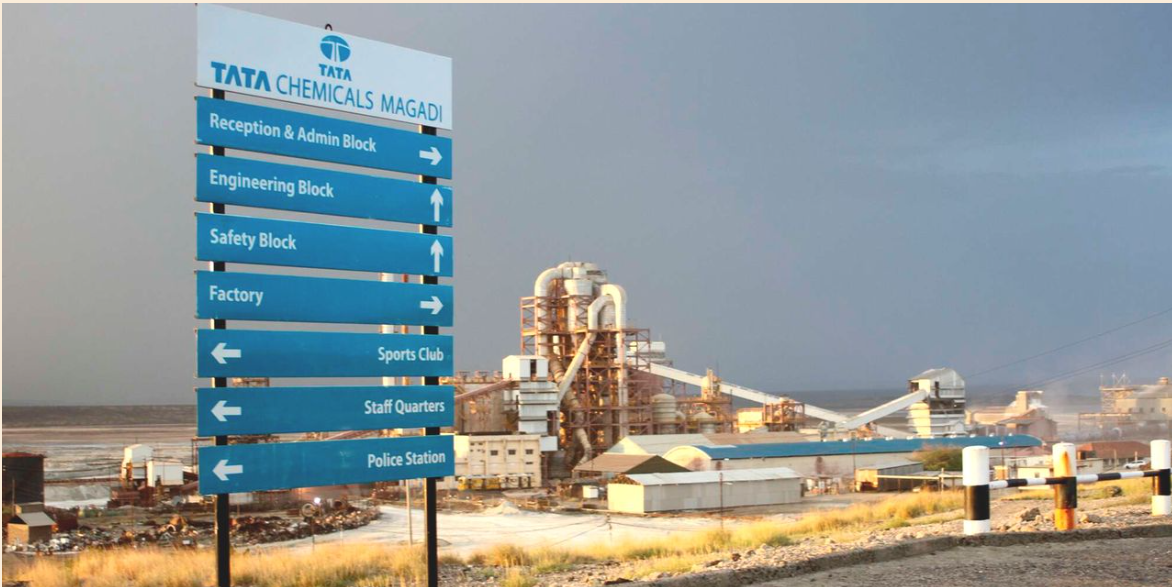
President Ruto’s recent remarks on Tata Chemicals Magadi have largely been interpreted through two competing frames. One sees a government asserting sovereignty over a national resource that should yield substantially greater benefits to the country and its host community. The other worries about what a confrontation with a long-established investor might mean for Kenya’s investment climate.
Both concerns are legitimate. But neither captures what is most consequential.
The larger question is whether Kenya can move from successfully extracting and exporting soda ash towards commanding more of the industrial system that soda ash makes possible, and whether that transition can be achieved without weakening the investment credibility required to finance the very factories that Kenya needs.
That is the real Magadi test.
During his Kajiado tour on September 3, the President argued that future investment around Magadi should include value addition of glass and chemical manufacturing, and that several investors could compete for opportunities around the resource.
Economically, that instinct is understandable. Soda ash is not an end product. It is an important input in glass, detergents and industrial chemicals, and numerous industrial processes. Tata says its Magadi operation is overwhelmingly export-oriented. In 2025, those exports amounted to about 254,780 tonnes and valued at approximately USD56.9 million or Sh7.36 billion.
This instinctively raises a policy question. If Kenya possesses the mineral resource, and already has the extraction infrastructure, how much of the subsequent manufacturing margin could reasonably be retained here?
That question, however, is more difficult than value addition sometimes suggests.
A glass factory does not become competitive merely because soda ash is available nearby. It requires reliable energy, appropriate silica and other inputs, specialized furnaces, technical skills, financing, efficient logistics and a market capable of absorbing production at scale.
The relevant policy question is therefore not whether Kenya can manufacture glass. It can.
The more useful question is whether Kenya can manufacture glass competitively enough for the industry to survive without indefinite protection, replace imports, and ultimately reach regional or international markets.
This distinction matters because beneficiation should be a means to industrial capability, not an end in itself.
Since the President’s Kajiado tour, much of the discussion has been framed around Tata Chemicals itself. Yet changing the identity of the operator is not necessarily the same thing as changing the economic model.
Competition can be useful because it could increase contestability, reduce dependence on a single company and allow the State to compare competing investment commitments. However, horizontal diversification, which means having more miners, does not automatically produce vertical diversification, which leads to more manufacturing.
Begs the question. Can Kenya redesign a long-standing extractive arrangement that it considers insufficient for its current industrial ambitions, while continuing to attract the capital required for the next stage of development?
Every mature resource economy eventually confronts this question as national priorities evolve.
And it has a name. It is called obsolescing bargain.
When an agreement obsolesces
First conceptualized by political scientist Raymond Vernon, the theory describes how the balance of power between a foreign investor and a host government shifts over time. Before capital is committed, the investor holds the upper hand, leveraging its technology and funds to secure generous tax terms and long concessions. However, once the investment is made and factories, mines, or facilities are physically built into the ground, that capital becomes immobile. The risk that once justified high returns evaporates, local personnel master the operational skills, and domestic political pressure mounts against the legacy terms.
Recognizing that the investor cannot easily pack up and leave, the host government uses its sovereign power to rewrite the rules, demanding higher royalties, forcing local value addition, or renegotiating the contract entirely. As countries develop, the initial agreement obsolesces, and their expectations of foreign investments evolve. Magadi appears to have reached precisely such a moment.
This does not necessarily imply wrongdoing by either party. It describes a structural change in bargaining power.
But the obsolescing bargain has an important second dimension. The incumbent investor is not the only audience. Future investors are also observing how the transition is managed.
This gives Kenya two objectives to pursue simultaneously. Obtaining greater developmental value from an established resource while maintaining the confidence necessary to finance the more sophisticated industries it now wants built around that resource. And these goals need not conflict.
Indeed, a clear and transparent redesign could strengthen Kenya’s investment proposition. Serious long-term investors do not necessarily require a promise that regulations, fiscal expectations or national priorities will never change. Few governments could credibly make such a promise.
What capital requires is greater certainty about how change occurs.
Rules can be demanding while remaining predictable. A country can require beneficiation, community participation, environmental compliance, skills transfer and local procurement without becoming inhospitable to investment, provided expectations are clear, measurable and institutionally administered.
In that sense, the Magadi transition presents an opportunity to demonstrate a more mature form of resource governance. The most important document may eventually not be whatever formalizes Tata’s departure, should that occur. It may be the agreement governing whoever comes next.
The Magadi concession could potentially be reconceived not merely as permission to extract a mineral, but as an industrial compact. Access to the resource could be linked to measurable commitments on downstream investment, Kenyan procurement, skills development, infrastructure, technology transfer and employment.
There is another dimension that is receiving insufficient attention. What exactly constitutes local benefit?
Employment matters, but a modern mining operation is capital-intensive and cannot be assessed only by the number of people employed. Corporate investment in schools, healthcare, water and community infrastructure also matters. And Tata’s CSR is not in question.
But we need to have an expanded definition of local benefit. How much procurement expenditure circulates through domestic enterprises? How many higher-level skills have been localized? Can local businesses participate in the downstream manufacturing ecosystem?
That is the difference between hosting a mine and building an industry.
Building the economy around the mineral
A mine can disappear when the resource, investor or concession disappears. Industrial capability can migrate. But a Kenyan maintenance company developed around Magadi can service other industries. Technical colleges established to support one industrial cluster can produce skills for several others. Glass manufacturing can connect into construction, beverages, pharmaceuticals, packaging and potentially renewable-energy supply chains.
This is why the deepest benefit from natural resources may not be the mineral itself. It is the accumulation of capabilities around it. Seen this way, President Ruto’s argument is potentially more ambitious than simply seeking additional factories. It raises the possibility of treating Magadi as the nucleus of an industrial cluster rather than primarily as an extraction site.
That ambition will not be the outcome of one tidy mining policy. Energy policy matters because furnaces and chemical plants are energy-intensive. Infrastructure matters because manufacturing competitiveness can disappear through high transport costs. Skills policy matters because sophisticated factories require technicians and engineers. Trade policy matters because domestic producers need access to sufficiently large markets. Finance matters because industrial plants require patient capital. And regional integration matters because products manufactured may ultimately extend beyond Kenya’s borders.
The question therefore changes. It is no longer simply, why are we exporting soda ash? It is expected that a sophisticated trading economy should export.
The higher utility question is, what else can Kenya competitively produce because it has soda ash?
That is a profoundly different industrial philosophy. It does not treat exports as evidence of failure. It treats the existing export industry as a platform from which to construct additional productive capabilities.
It also provides a more balanced way of assessing Tata’s legacy. The company has operated a significant export business, provided employment and supported community services. Those contributions should not be erased merely because national expectations have evolved.
Equally, past contribution does not require Kenya to conclude that the existing structure represents the highest economic use of the resource indefinitely.
Both propositions can be true. The government can recognize what has been built while asking whether the next phase should produce more. Ultimately, that is what makes Magadi an important national economic question rather than simply a corporate dispute.
Finally, my unsolicited advice is to both critics and supporters of the Magadi controversy. The test will not merely be whether one investor leaves and another arrives. Nor should it be measured by how forcefully Kenya asserts ownership over a resource that is unquestionably located within its borders. The more meaningful measure will be what exists around Lake Magadi ten or twenty years from now.
What comes after the mine
Medieval England’s transformation did not come from ceasing to value wool. It came as progressively more labour, skill, enterprise and commerce accumulated around the fleece before it crossed the border. The commodity remained valuable. But the economy surrounding it created even more value.
President Ruto has effectively tabled that conversation around Magadi. Kenya already owns the soda ash. The next challenge is determining how much more Kenya should gain from the knowledge, manufacturing, enterprise and value created around it. If these outcomes emerge, the significance of this moment will look considerably larger than the Tata controversy that produced it.
The power of producing wealth is therefore infinitely more important than wealth itself — Friedrich List