In 1919, the Fisher brothers signed a ten-year contract to supply closed car bodies to General Motors. The arrangement required both firms to invest in assets that neither could easily redeploy elsewhere. Fisher built stamping dies and plants tailored to GM’s designs, while GM organized its production schedule around Fisher’s supply.
No contract, however carefully drafted, could specify every contingency the relationship would face. It could not fully anticipate what Fisher should charge if demand surged, how quickly GM’s designs might change or who should absorb the cost of retooling when they did. For a time, the gaps in the agreement did not matter. Both firms gained more from cooperation than from testing the agreement’s limits.
But as GM’s needs expanded and its designs changed faster than the contract had anticipated, the parts of the relationship left unwritten became those that mattered most. Each side suspected the other of extracting value from those gaps. The question of who controlled decisions stopped being a negotiation and became a fact of ownership. Eventually in 1926, General Motors bought Fisher Body.
Economists Sanford Grossman and Oliver Hart called this the residual rights of control. They posited that ownership is not merely a formality. Because no contract can anticipate every future circumstance, some decisions will inevitably remain unspecified. Ownership determines who has the final authority to make those decisions. In any relationship that creates real value, someone ultimately holds these residual rights of control, whether it was openly negotiated or not.
Linda Mwananchi is precisely at such a moment.
What is the contest?
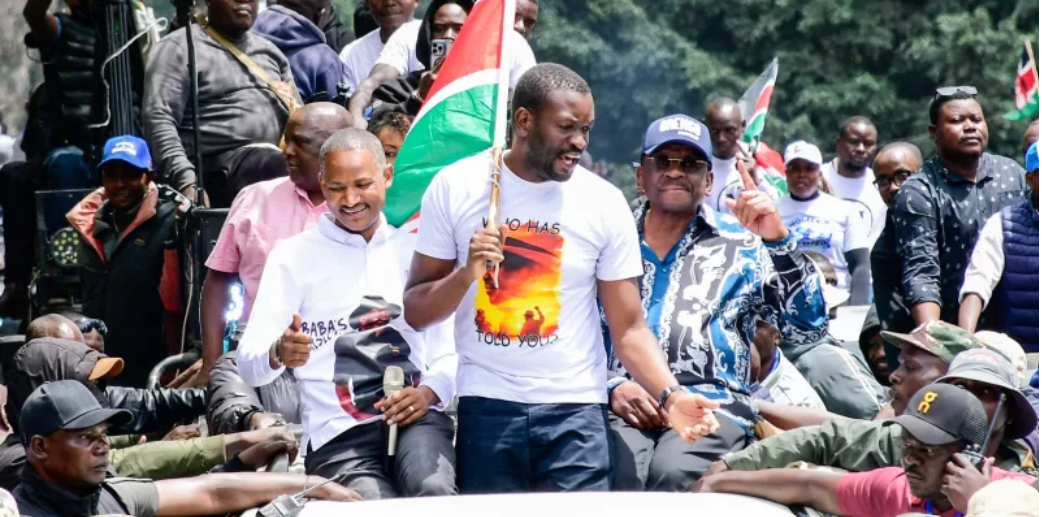
Nairobi Senator Edwin Sifuna’s presidential bid and Embakasi East MP Babu Owino’s gubernatorial bid for Nairobi appear non-competing on the surface. But an elective office is not the same thing as the value that gets created on the way to it.
Linda Mwananchi has a recognizable brand, crowds and media attention, but no settled institutional form. Its leadership hierarchy remains unclear, while several principal figures remain members of other parties they could eventually compete against. Yet ambiguity changes character once a movement becomes valuable. What begins as flexibility becomes a struggle over residual control.
Begs the question, what is the contest?
The real question is not who leads Linda Mwananchi, but who ends up owning its crowds, brand recognition, public goodwill, and who negotiates coalitions and approves candidates. Until that is resolved, every large rally remains a negotiation over ownership.
Whether written or not, Linda Mwananchi’s division of labor between Sifuna and Babu is effectively a contract. Sifuna takes the presidency, and Babu takes Nairobi governorship, and each campaigns for the other’s ticket.
This is a perfectly workable contract for the cases it anticipated, but it is silent on the one thing that matters most, similar to Fisher and GM’s contract. Who owns the movement’s actual capital once it has been built?
This is why the events surrounding last week’s Jacaranda rally matter.
Sifuna and Babu operate on overlapping political territory, drawing energy from similar urban constituencies while responding to different electoral incentives. Sifuna needs the movement to expand nationally quickly so that he can emerge as a plausible presidential centre of gravity. Babu needs it to remain internally open and politically plural, supporting his Nairobi ambitions without reducing him to a mobilization asset for somebody else’s ascent.
It is therefore not surprising that two days after the Jacaranda rally, Babu announced that he would attend fewer rallies and concentrate on his Nairobi gubernatorial campaign. He also disclosed that he has his own political party, even as he reaffirmed his support for Sifuna’s presidential bid. The timing reveals the structural tension inside Linda Mwananchi.
Babu’s advantage is his command and mobilization of urban street-level politics. He has a constituency base, draws youthful crowds and an ability to convert political language into street energy. His gubernatorial ambition gives him a clearer near-term electoral market. Winning Nairobi requires ward agents, candidates, polling networks, money and alliances that survive beyond a rally’s excitement.
By concentrating on Nairobi, Babu may not be retreating from Linda Mwananchi. He will be accumulating the political assets that give him greater bargaining power within it.
I submit that this is the non-obvious meaning of his separate party. It lets Babu negotiate nominations, coalitions and resources without depending on another person’s goodwill. He can support Sifuna while retaining the capacity to move independently if Linda Mwananchi leaves him exposed.
That is hedging, not hostility.
Who owns the machinery?
The difficulty is that each man’s success can alter the balance between them.
If Sifuna becomes firmly established as the presidential candidate, Linda Mwananchi’s Nairobi machinery may increasingly be expected to serve his national campaign. Babu would then risk supplying crowds, local networks and political theatre while receiving uncertain control over the gubernatorial ticket and city campaign.
If Babu builds a formidable independent Nairobi operation, the reverse problem arises. Sifuna could become the movement’s national voice while depending on a city machine whose loyalty is personal to Babu. The presidential candidate would own the message, but not necessarily the organization required to carry it.
Fisher’s dies were on paper worthless to anyone but GM. This was supposed to leave Fisher with little leverage, except that Fisher owned them, and GM needed its cooperation more urgently than the original contract implied.
Babu’s Nairobi machine is his own version of the dies. It is an asset built for a specific purpose, controlled by one party, and worth considerably more to Sifuna’s national campaign than it costs Babu to maintain independently.
But a national operation and a local one are not the same asset. Sifuna requires breadth across several counties, while Babu requires depth in one. Both, however, need the same granular, ward-by-ward capacity to register people, and mobilize them to vote. Seen from this perspective, breadth wins arguments about who should lead a movement, while depth decides who actually can, once the movement stops rallying and starts organizing a ballot.
A man building his own political outfit for a takeover five years out, which is what Babu has openly stated, has little reason to fold its capital into a joint venture he does not control, unless that venture gives him something he cannot build alone.
That is the test Babu must apply to Linda Mwananchi which currently gives him visibility, sympathetic crowds and a platform larger than his constituency. But it does not give him a secure gubernatorial ticket, a national party structure or control over the coalition through which either ambition must eventually pass.
His separate party answers the control problem but not necessarily the scale problem. A politician may own a party completely and still own very little of political value. Registration papers confer the right to issue certificates, but they do not automatically produce county branches, polling agents, financiers or an electorate accustomed to voting for the party’s symbol. Residual control matters only when the asset being controlled is valuable.
This is the danger in Babu’s present strategy. He could spend the next five years protecting his independence only to discover that he controls a vehicle too small to carry his ambitions. A personal party may strengthen his hand in Nairobi, but a presidential campaign requires inherited loyalties, institutional memory and political relationships that cannot be assembled just before an election.
Nairobi, 2027 and the road to 2032
Nairobi presents a further difficulty. Winning the governorship would give Babu an enormous platform, but it would also place his future inside Kenya’s most unforgiving administrative office. Nairobi governors inherit expectations they cannot satisfy with powers they do not fully possess. Every blocked drain and uncollected heap of rubbish becomes a personal referendum on the governor. The office produces exposure faster than it produces achievement.
More importantly, Nairobi is not a political homeland. Its electorate is large but fluid and fragmented. It can make a politician famous without making him nationally rooted. Therefore, a 2027 Nairobi victory would not automatically deliver a dependable presidential bloc in 2032.
And this is where Sifuna’s incentive differs. Sifuna can use Linda Mwananchi to claim national breadth because his immediate objective is to become the voice around which a coalition may form. Babu requires something more durable such as a territory from which he can negotiate such a coalition. If he supplies Sifuna with Nairobi’s crowds while Sifuna accumulates the national relationships, Babu may help manufacture a presidential candidate whose existence postpones his own turn.
Sifuna needs urgency. His national campaign must acquire momentum before established coalitions consolidate around rival candidates. Babu’s presidential timetable begins after 2027. He therefore needs patience, an executive record and relationships with the forces likely to shape the succession. What strengthens Sifuna immediately, weakens Babu eventually.
The contradiction at the centre of Linda Mwananchi is therefore contractual, not personal. Both men can sincerely support each other today because today’s benefits are divisible. The trouble begins when the movement’s benefits cannot be divided such as which party absorbs the other, who appoints officials, where campaign money goes, and whose future is deferred when the coalition expands.
Babu must consequently decide whether he wants to maximize his bargaining power in 2027 or his presidential viability in 2032. These objectives overlap, but they are not identical. Owning a small party and contesting Nairobi may give him the stronger hand in the upcoming election. It may not give him the institutional base, governing record and alliances required for the election after that.
Fisher’s mistake was not that it invested. It was that the value of its investment became inseparable from a larger system whose strategic direction it could not determine. Babu risks constructing the political equivalent of a Nairobi machine valuable enough to power another man’s national campaign, but too geographically narrow to secure his own presidency later. He may own the dies while Sifuna, and other political parties, compete to own the assembly line.
The harder, better move
Finally, my unsolicited advice is to Babu. Politics often mistakes every adjustment for betrayal and every shared platform for permanent unity. But if you are serious about becoming president in 2032, the harder but better move is to eat humble pie, return to ODM, support the UDA–ODM 2027 coalition and negotiate the Kisumu ODM gubernatorial ticket, which you would win effortlessly. Then spend one term governing Kisumu well.
Kisumu offers what Nairobi cannot: an anchored political base, executive experience and a credible claim to regional succession. Supporting UDA–ODM will allow you to build the relationships and reciprocal obligations you will need when the incumbent coalition confronts the 2032 succession. You would surrender some residual control today but acquire a far more valuable asset for tomorrow. Sometimes the man who eventually buys GM must first resist the temptation to remain Fisher Body.
A man who wants to lead the orchestra must turn his back on the crowd — Max Lucado