Inter arma enim silent leges.
In the winter of 53 BC, the Roman Republic found itself unable to hold an election, not because there was a plague, war or lack of candidates. The problem was that two rival politicians, Publius Clodius and Titus Milo, had each assembled private armies of hired muscle, and the streets where citizens were supposed to vote belonged to whoever had paid for the most muscle that morning. Subsequently, elections were postponed and postponed again, as intimidation displaced persuasion, and private force overwhelmed public authority.
In January 52 BC, the rival gangs encountered each other on the Appian Way. Clodius was killed. His enraged supporters carried his body into the Senate house, tore up its furniture and used it to build a funeral pyre, cremating him as the building burned around his corpse. Order returned only after Pompey was appointed sole consul and surrounded Rome with soldiers.
At Milo’s murder trial, Cicero his lawyer, the most celebrated advocate of his age, rose to deliver the defence. But when he looked up and saw armed troops surrounding the court, his confidence deserted him. He faltered, delivered only a fragment of his argument and sat down. The polished speech he later published contained the line the moment demanded but the courtroom never heard. Inter arma enim silent leges - when weapons speak, the laws fall silent.
The Republic did not die in a single dramatic moment the day Caesar crossed the Rubicon three years later. It gradually died one street corner, one rented mob at a time.
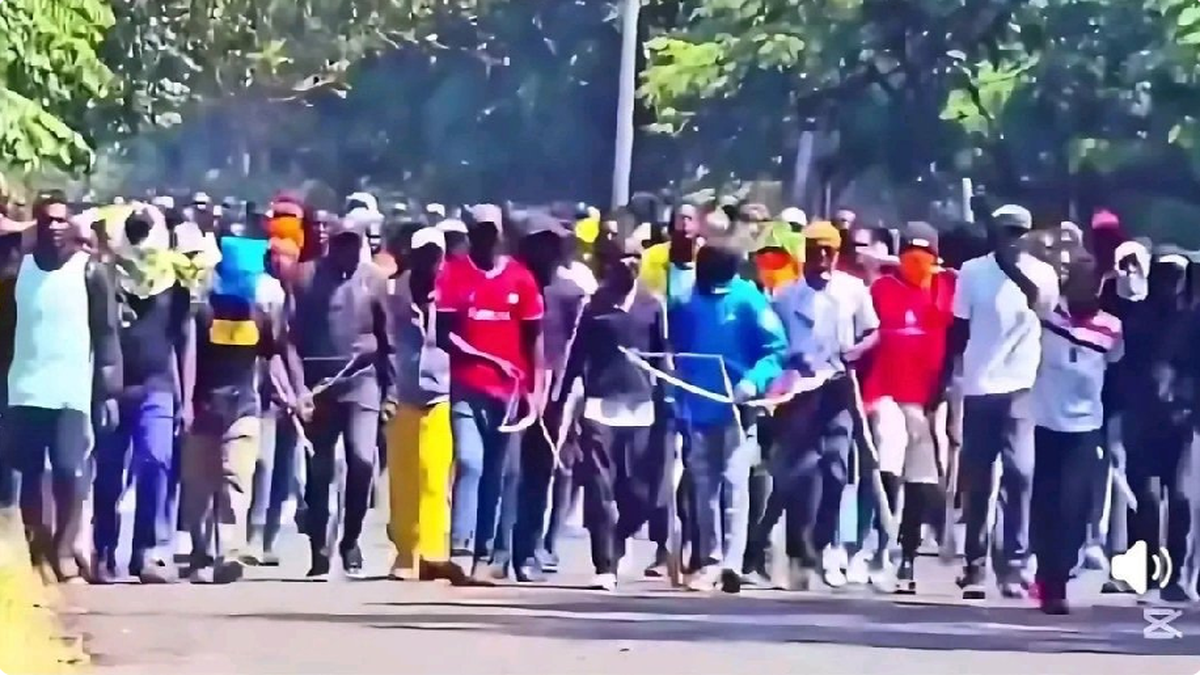
Fast forward to present day, Kenya is presently running the same procurement and calling it goons. Our media often reports that rallies were disrupted by goons, meetings were stormed by goons, mourners were dispersed by goons. It is always goons arriving ownerless, like the weather.
The public story
Compare this passive vocabulary with previous ones, which were at least honest about ownership. KANU had youthwingers, ODM had Men in Black, Mungiki and Chinkoro were allegedly reported to have roots in Central and Kisii regions, respectively. Each had a geography, a patron, and an identifiable characteristic. Goon has none. And that softening of vocabulary is not an accidental drift. It is the linguistic signature of a practice becoming institutionalized because it solves problems for its users.
Begs the question. Does Kenya have a goon problem?
Imagine a successful company that owns neither factories nor delivery trucks. It simply connects customers to suppliers, leaving production, logistics and risk to others. Today, taxi companies don’t own fleets, hotels don’t own buildings, and retailers don’t manufacture what they sell. Economists call this outsourcing. Ronald Coase, the Nobel Prize-winning economist, argued that every organization constantly weighs one question. What should we do ourselves, and what should we contract out?
I submit that the same question, uncomfortable as it may sound, increasingly explains a disturbing feature of our politics. Much of the public discourse on goon culture assumes that it is a moral failure of individuals or a temporary lapse in political judgment. Yet the persistence of the phenomenon across successive governments, political parties, and election cycles suggests something deeper. The phenomenon persists because it solves real coordination problems in a political marketplace defined by weak institutions, high stakes, and short time horizons.
We therefore need to discard the word goon and describe the thing. What Kenya has is not a goon problem. It has a violence market. And markets, unlike morals, obey knowable laws of demand, supply, brokerage, and price discovery.
But because we are lazy thinkers, we attribute procurement of goon labor to unemployment. Yet it is a structured, recurring feature of how power is performed, contested and consolidated. The Purpose Of a System Is What It Does. POSIWID. Not what its designers intended, nor what its spokesmen announce. A political system that reliably produces rented violence at every contested election, event or protest, is not malfunctioning. The goon is not a bug in Kenyan democracy. He is one of its stable outputs, as regular as a woman’s periods and considerably more punctual.
Politicians do not hire disruption because they are wicked, but because it is the cheapest instrument in the political toolkit. Persuasion strategies through manifestos, rallies, merchandise, townhall meetings, and the slow compounding of trust, is ruinously expensive. Equally, is the mobilization gap. Kenya’s formal party structures remain thin outside election seasons. Membership is fluid, and ideology often ornamental. When a rapid turnout is required for a Tuesday protest in Nairobi, or a Thursday rally in Ol Kalao, politicians cannot rely solely on volunteer networks. They turn to brokers who understand the local economy of grievance and survival and can quickly mobilize the actors because disruption costs a day rate and it converts an opponent’s rally from an asset into a liability within minutes. If you measure this in cost per vote denied, nothing else in politics comes close.
I submit however, that the deeper commodity being purchased is not the violence itself. Violence has never been the point. It is simply the visible manifestation of an invisible transaction where loyalty is rented, fear is traded for access, and chaos is managed as a business expense. What the politician actually buys is distance, which is the gap between the act and the procurer that gives him plausible deniability.
This is a form of reputational arbitrage. One party possesses influence but cannot afford association with violence, while the other has no political reputation to protect. Money bridges that gap. The politician purchases insulation from blame thus creating distance from the act itself, and its consequences.
Now on the supply side, we need to resist the cliché that unemployment breeds goons. That is as true as saying that gravity explains a plane crash. It is accurate but useless. We should view this through the lens of relative deprivation. Men do not outsource their violence because they are poor. They do so because the gap between what they believe they deserve and what they can realistically attain through legitimate means becomes too wide to ignore. Poverty may empty the pocket, but relative deprivation unsettles the mind. The issue, then, is not simply that young men are unemployed because absolute lack does not often fuel mobilization. It is the daily mockery of seeing prosperity, power and influence all around them while the legitimate routes to attaining them appear blocked. Politics offers them the shortcut and the sense of relevance for an afternoon.
Between demand and supply sits the market's true entrepreneur. The invisible broker. He aggregates the vijana, holds the M-Pesa float, and critically insulates the politician who never meets the muscle. By the time the transaction reaches the street, it has the untraceable quality of a shell-company chain where coercion is held off the balance sheet, deniable, unregulated, and systemically load-bearing.
Before we point fingers, remember that the violence market is a bipartisan infrastructure. Every bench in our politics condemns goons, yet they find their events mysteriously well-attended by muscular strangers with the same young men wearing different identifiers a fortnight apart. This is not hypocrisy. It is simply the labour market clearing. You cannot blame a single bidder for the existence of an auction.
The public condemnations should therefore be understood as the market's advertising with each side performing victimhood, while its procurement continues, because the incentive structure is perfectly symmetrical and no actor can unilaterally disarm without conceding the cheapest instrument to his opponent. It is a textbook collective-action trap. So, if every political formation in Kenya condemns goons, who exactly is hiring them? The answer is everyone, which is why the answer is no one.
The final test
Finally, my unsolicited advice is twofold. First to the financiers. Violence markets do not disappear when the political demand subsides. They diversify. The contractors who once waited to be hired, gradually discover that coercion itself is a business model. So instead of responding to demand, they begin manufacturing it. The skills acquired in politics become transferrable to other informal markets such as transport and market levies, land disputes and neighborhood protection rackets. Violence, once rented, becomes vertically integrated.
Secondly is to the goon labor. Read your contract. You will notice you don’t have one. You are participants in the only labor market where the seller carries the entire downside of the transaction. Ordinarily, the risk bearer charges the premium, yet you have inverted this ancient arithmetic. For a day rate, you underwrite another man's ambition while he retains full equity in the outcome. If the gambit succeeds, the seat is his. If it fails, the charge sheet is yours. You are not muscle in this economy. You are inventory.
Listen closely. Your Kshs 500 daily wage already includes your abandonment. It is full and final settlement for your future where the buyer priced his deniability into the transaction before you boarded the lorry. And the irony is when the man who hired you reconciles with his enemies over a buffet, you will not be invited.
Yet, in a marketplace that rewards speed over structure, you already master the logistics of rapid mobilization, the pricing of risk, coordination under pressure, local brokerage, and signaling discipline. Convert these competencies into durable, collective assets and become the indispensable infrastructure that outlasts any election cycle.
If a Prince holds his State on the basis of mercenary arms, he will never be firm or secure - Niccolò Machiavelli, The Prince.