Nishiyama’s coastal gamble
Yataro Nishiyama was an influential Japanese industrialist, metallurgist, and executive who served as the founding president of Kawasaki Steel Corporation. In the early 1950s, he proposed building an integrated steelworks at Chiba on Tokyo Bay. Very few people thought this was a sensible idea in post-war Japan.
His proposal was met with fierce skepticism including from the Bank of Japan Governor, Hisato Ichimada who ridiculed the plan, predicting that Kawasaki would stall and weeds would grow on the Chiba works. Some observed correctly that the Chiba shoreline was shallow, and a channel had to be dredged before large vessels could reach it. Others questioned where the feedstock would come from because at the time, Japan possessed almost no domestic iron ore or coking coal.
The sea as a raw material pipeline
Yataro’s response was that it would come from wherever it was cheapest, by ship. His bet was that the sea itself would act as the raw material pipeline. Despite all the skepticism, Yataro remained unfazed and he pressed forward to construct Japan’s first modern, coastal integrated steel plant.
By designing a deep-water facility capable of processing bulk imported minerals right at the water’s edge, Kawasaki Steel bypassed geographical constraints of resource ownership, serving both the domestic industrial heartland and lucrative global export routes, and ultimately proving that strategic coastal access and processing scale, matter far more than owning what lies beneath the soil. It imported ore from Canada, India and later Brazil in large carriers more cheaply than many ore-rich countries could move their own mineral inland. Within a generation, Japan became one of the world’s great steel exporters.
Today, the legacy of Kawasaki Steel lives on through JFE Holdings and is Japan’s second-largest steelmaker and a global industrial pillar generating over $30 billion in annual revenue with a workforce of nearly 58,000 across its consolidated group. Nishiyama’s gamble at Chiba did far more than build a single company. It anchored an entire industrial ecosystem, driving upstream innovations in deep-sea bulk shipping and global mining finance while fueling downstream giants across Japanese shipbuilding, automotive manufacturing, and high-speed rail.
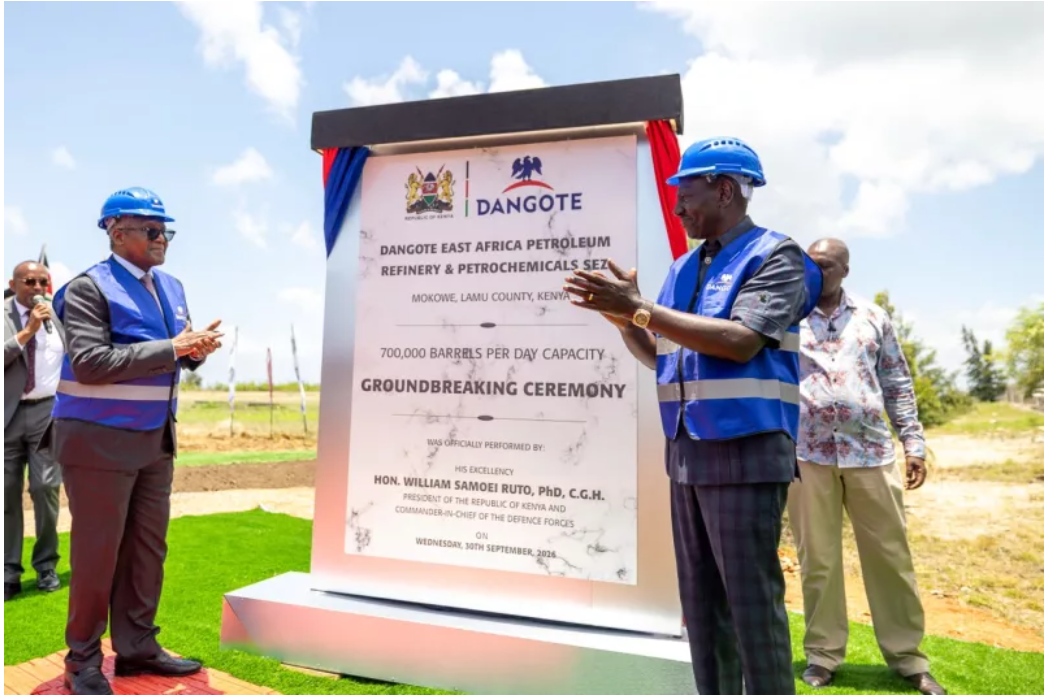
This week, Lamu invited a similar question. President Ruto alongside Aliko Dangote, a Nigerian industrialist, founder, and CEO of the Dangote Group, broke ground for a $16 billion refinery that is designed to process 700,000 barrels of crude a day.
Lamu’s difficulties: the price of starting
The skeptics, echoing the same establishment doubts that once met Kawasaki Steel, have raised a formidable array of criticisms. On feedstock, they question where 700,000 barrels of daily crude will originate given that regional fields in Turkana and Uganda remain constrained by pending pipeline connections and production limits.
On logistics, observers point out that Lamu currently lacks operational bulk oil storage terminals, localized pipeline networks, and deep-water offloading infrastructure required to handle mega-tankers without chronic congestion.
Environmentally, residents across the archipelago, along with local fishing cooperatives, have raised alarms over coastal pollution, destruction of fragile mangrove ecosystems, and unresolved land compensation claims in areas like Hindi/Manda Magogoni.
Beyond these immediate hurdles, broader economic and political doubts persist. Geopolitical analysts warn of the security risks of placing critical energy infrastructure near unstable border zones, climate strategists question locking capital into heavy fossil fuel processing during a global energy transition, and sovereign debt experts warn that state participation, even through minor equity stakes, could expose regional treasuries to contingent liabilities if project completion or off-take agreements stall.
Every one of these objections has been cited often with the implication that the difficulties themselves constitute an argument against proceeding.
That implication confuses the nature of industrial ambition with the comfort of perfect foresight. Large refining capacity is not a discretionary adornment for East Africa. It is a structural requirement if the region intends to move beyond permanent status as a net importer of refined fuels. Kenya, Uganda, South Sudan, Rwanda and the eastern Democratic Republic of Congo together form a market large enough to justify domestic processing. The alternative is continued dependence on products whose prices and availability are determined elsewhere. The Lamu project is an attempt to reverse that dependence.
Begs the question. Are Lamu’s difficulties reasons to stop or simply the price of starting?
The myth of feedstock first
The economist Albert Hirschman called this the Hiding Hand. We undertake some ambitious projects without knowing the full difficulty ahead. Once committed, we discover the ingenuity, partnerships and institutional capacity needed to complete them.
Nishiyama did not make Chiba viable from Japan’s iron ore. He changed the question and asked, if the ore could arrive by sea, where should the steel be made?
The project’s critics ask where Kenya will find 700,000 barrels of crude a day. They are right that Turkana alone cannot supply it. But their conclusion does not follow. A refinery’s stated capacity is the maximum it is designed to process, not a promise that Kenyan oilfields must produce that volume every morning. A coastal refinery can import crude. Its viability depends on the delivered price of that crude, the cost of processing it and the price at which it can sell its products. Owning the oil beneath the ground is one possible advantage. It is not a condition for entering the refining business. In addition to sourcing from Nigeria, Dangote refinery also imports crude from United States, Libya, Guyana and United Arab Emirates.
Switzerland built a world-famous chocolate industry without growing cocoa. The cocoa trees grow elsewhere, but the skill of turning their harvest into a valuable product took root in Switzerland. Why, then, should the absence of enough Kenyan crude settle the question of whether Kenya can refine oil?
It is an established fact that talks are underway on a pipeline from Turkana's fields to Lamu that would feed the refinery. Hirschman called this a backward linkage. This is a large downstream investment that creates the pressure, and the business case, for the upstream investment that was not going to happen on its own. The feedstock critics are treating the absence of a pipeline as a reason not to build the refinery. In reality, the absence of a refinery is a large part of why there is no pipeline.
Markets, costs and public exposure
The same error appears in the claim that Kenya lacks a market large enough to absorb the output. Kenya alone is not the market on which a plant of this scale is being proposed. East Africa already buys substantial volumes of finished petroleum products from elsewhere. Estimates indicate a regional demand at roughly 30 million tonnes a year. The commercial task is to win a share of those purchases, consistently and at a competitively delivered price.
The other argument is that distance costs money. Of course it does. So does shipping finished fuel to East Africa after refining it somewhere else. The relevant comparison includes crude freight, processing, storage, product transport and the margins taken along both supply chains. You cannot add transport costs to Lamu’s side of the ledger, while treating imported finished fuel as though it materializes at Mombasa free of them.
Then there is the claim that Kenyans will be left paying for the refinery if it fails. Kenya does intend to invest. It has been allocated a 10 per cent stake, and Treasury says it may take up additional shares if neighboring governments decline theirs. That makes public exposure a legitimate question. But owning shares is different from guaranteeing all of Dangote’s debts or agreeing to cover the refinery’s operating losses.
Admittedly, Lamu does not yet have all the storage and marine facilities the refinery will need. They will have to be built, and someone will have to pay for them. That is a fair concern. But for years, LAPSSET has had plans for oil terminals and transport links without an industry large enough to press for their completion. A refinery changes that calculation. It gives the corridor a customer with specific requirements and a reason to finish the work.
Industrial ambition and the credit for delivery
I submit that President Ruto unapologetically deserves credit for choosing to engage that scale of challenge. It would be easier to continue importing finished products, describing industrialization in policy documents and leaving the difficult investments to other countries. His administration’s support for this project makes a larger claim that Kenya can host the processing, logistics, skills and regional trade which it has long paid others to provide. When Kenyan technicians operate the plant, Kenyan firms maintain its equipment, local businesses qualify as suppliers and Lamu gains infrastructure useful beyond the refinery, the project will have built an industrial capability as well as a facility.
The guest list said as much. Heads of state do not travel to the groundbreakings of projects they expect to fail. While attendance is not an offtake agreement, but in a region where cross-border infrastructure lives or dies on political goodwill, their presence is the closest thing to a letter of intent for the market, crude and equity the refinery needs.
From vision to delivery
Finally, my unsolicited advice is to Kalonzo Musyoka and others claiming that Ruto should not take credit because the refinery was mooted long before his time. You are right about the history, but wrong about what it proves. The computer mouse was invented by Douglas Engelbart at the Stanford Research Institute in the 1960s. Xerox then refined it in its Palo Alto laboratory in the 1970s and fitted it to machines that few people bought. But it was Apple that is widely credited with bringing the mouse to ordinary desks through the Macintosh in 1984. A refinery at Lamu was indeed part of the LAPSSET vision launched under Kibaki in 2012 when you were Vice President. But it remained an idea for fourteen years. Whoever closes the financing and breaks ground has done the part that ideas cannot do on their own. The past had an owner. You were it. The present too has an owner. It is President Ruto.
Resources are not, they become - Erich Zimmermann